
Lighting a terrace: lanterns, warm light and the stars
Good terrace lighting is mostly a matter of restraint: a few warm, low lights in the right places, and enough darkness left over to see the stars.
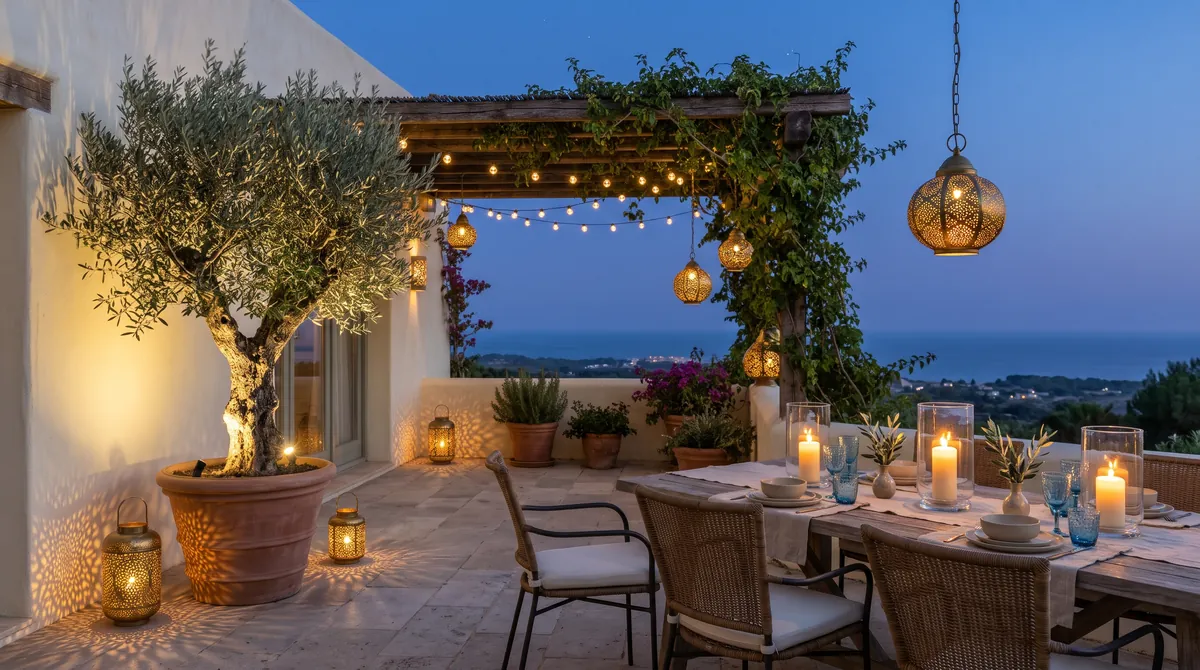
The first hour after sunset is the best one on a terrace. The stone gives back the warmth of the day, the cicadas fall silent and the crickets begin, and the sky over the hills turns from apricot to deep blue. This is the moment when many people reach for a switch and flood everything in white light, and the spell breaks. Try the opposite one evening: a lantern on the table, a candle in a glass, a soft glow on the wall behind the olive tree. Your eyes adjust, faces look warmer, and slowly the stars appear.
Think in layers
A well-lit terrace is not lit by one powerful lamp but by several modest ones, each with its own job. Lighting designers speak of layers, and the idea is useful for any outdoor space, from a balcony to a large garden.
| Layer | What it does | Examples |
|---|---|---|
| Ambient | A general, gentle glow so that you can move about and see faces | Wall lights, string lights under a pergola |
| Task | Clear light where you work or where you could trip | The outdoor kitchen, steps, the path to the gate |
| Accent | Draws the eye to a feature and gives the darkness depth | An olive tree lit from below, a wall washed with light |
| Decorative | Atmosphere, movement and pattern | Lanterns, candles, hurricane lamps |
Few terraces need all four everywhere. Start with the task light you need for safety, add a little ambient light, then choose one or two accents. Decorative light comes last, and it is often the part that people remember longest.
Warm light, low glare
Colour temperature, measured in kelvin, describes how warm or cool a light looks. For a terrace, aim for warm light of about 2200 to 2700 kelvin, the colour of candlelight and old filament bulbs. It flatters skin, stone and leaves, and it feels relaxed. Cold white light makes even a beautiful terrace look like a car park, so avoid it outdoors wherever people sit.
Glare matters as much as colour. A bare, bright source at eye level makes everything around it seem darker and dazzles anyone sitting opposite. Choose shielded fittings that point downwards and hide the light source, and dimmable fittings where you can, so that you can lower the light as the evening goes on.
Downward, shielded light has three further benefits. It protects the night sky, it does not dazzle your neighbours or shine into their windows, and it attracts fewer insects to the table. That last point alone is a good reason to keep light low and warm.
Fittings for the weather: IP ratings
Outdoor fittings carry an IP rating, a code that describes how well they are protected against dust and water. The second digit refers to water, and the higher it is, the better the protection. As a guide:
- IP44 protects against splashes and suits sheltered wall lights under a roof or a deep eave.
- IP65 or higher is right for exposed places where lights face driving rain or are hosed down with the terrace.
- IP67 is needed for fittings set into the ground, such as uplights beneath a tree, which may stand in water after a storm.
Near the sea, look at the material of the housing as well. Salt air corrodes poor metal quickly, while stainless steel, brass and well powder coated aluminium last much longer.
Safety, power and solar lights
Light on steps and paths is not a question of mood but of safety. Every change of level, every step down to the garden and the route to the gate should be lit well enough to see the edge. Low step lights, or small fittings set into the wall at ankle height, do this without glare.
Fixed outdoor installations should always be carried out by a qualified electrician, with the circuits protected by a residual current device that cuts the power in the event of a fault. Water, metal and bare feet are a poor combination, and outdoor cables, sockets and junction boxes need proper protection. Timers and motion sensors make lighting easier to live with: a timer switches ambient light off at a sensible hour, and a sensor on the path lights the way only when someone is there.
Solar lights are useful wherever cables cannot reach, in a far corner of the garden or along a long drive. Their brightness is limited, especially after cloudy days and in winter, so treat them as markers and accents rather than as task lighting. LEDs have made all outdoor lighting far more efficient, which means a terrace can be lit beautifully on very little power.
Mediterranean lanterns
Some of the most beautiful terrace light comes from the oldest kinds of fitting. Pierced metal lanterns from Morocco scatter patterns of light across walls and floors, turning a plain corner into something to look at. Glass hurricane lamps protect candle flames from the evening breeze and can stand on the table between the dishes. Terracotta lanterns, with their warm, earthy glow, sit naturally among pots of herbs and on low walls.
Group lanterns rather than scattering them one by one: three on a step, a cluster at the end of the table, one by the door. With candles, keep the flames well away from curtains, awnings, reed mats and dry plants, and never leave them burning unattended.
The light you do not switch on matters as much as the light you do.
Keeping the stars
Many people come to the Mediterranean countryside to see the stars, and too much light hides them. A single unshielded floodlight can wash out the sky for every house around it. The remedy is simple: point light downwards, use only as much as you need, keep it warm and switch it off when you go to bed.
On a clear night, turn everything off for ten minutes and let your eyes adjust. The sky that appears, from the faint band of the Milky Way to the slow blink of a passing aircraft, is the best reason of all for lighting a terrace with restraint.
Questions and answers
What colour temperature is best for a terrace?
Warm light of about 2200 to 2700 kelvin creates a relaxed mood and flatters skin, stone and plants. Cold white light feels harsh outdoors and is best avoided where people sit.
Which IP rating do outdoor lights need?
IP44 is enough for sheltered wall lights protected from direct rain. Exposed fittings should have IP65 or higher, and lights set into the ground need IP67.
Are solar lights bright enough?
Solar lights are useful where there are no cables, but their brightness is limited, particularly after cloudy days and in winter. Use them as markers and accents rather than for steps or cooking.
How can I light a terrace without disturbing the neighbours?
Choose shielded fittings that point downwards, use warm, dimmable light and put ambient lights on a timer. Light that stays on your own terrace is kinder to the neighbours and to the night sky.
Further reading in our network
- glaminiaDesigner lighting
Designer lighting, from table lamps and lanterns to fittings for gardens and terraces.
- sunalivSolar and smart living
Solar and smart living, with ideas for using the sun’s energy around the house and garden.
Our articles are general information written with care. Building work, roof loads, electrics, gas and fire need qualified professionals and local permits; plant care depends on your own climate and soil.