
Rattan, rush and esparto: natural fibres for house and terrace
Cane chairs, rush seats, esparto mats and palm baskets: what each natural fibre really is, where it belongs and how to keep it beautiful for years.
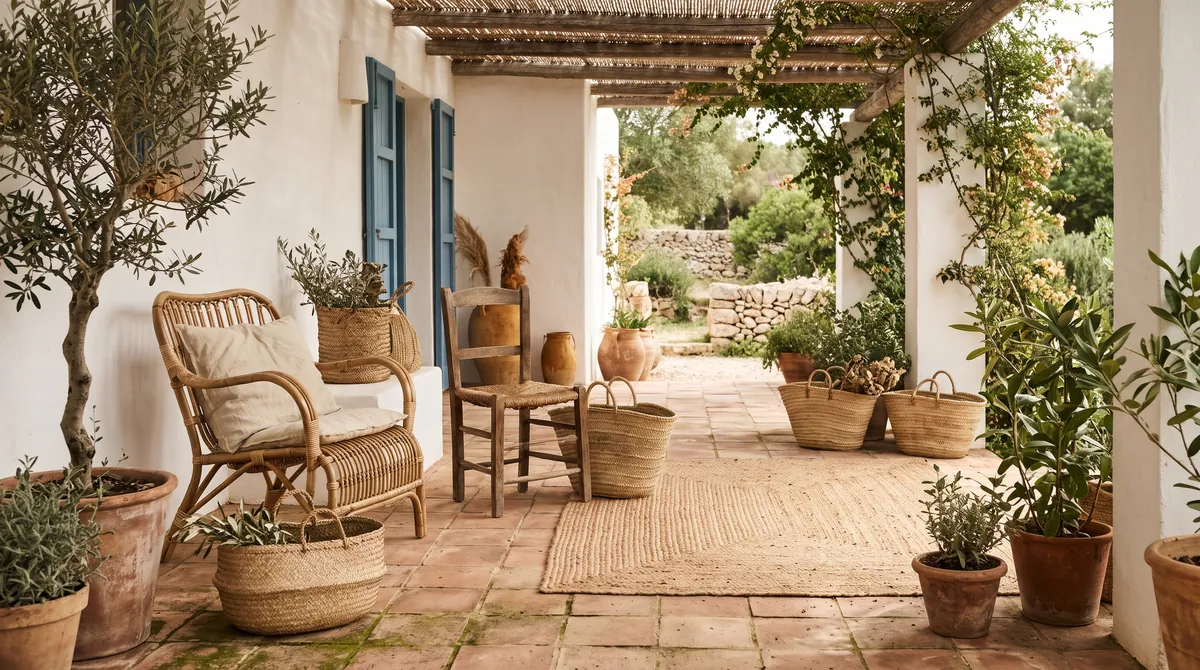
After lunch, when the terrace falls quiet, the old cane chair creaks as you settle into it. The seat gives a little, the woven back holds the shape of every summer it has known, and through the reed blind the light falls in thin gold stripes across the floor. On the table sits a palm basket of figs, and under it an esparto mat worn soft at the edges. None of these things is precious, yet together they feel like the Mediterranean itself: light, cool and made by hand from plants.
Rattan and cane: a palm that becomes furniture
Rattan comes from climbing palms of tropical forests, mainly in Asia, which scramble up through the trees on long, slender stems. Unlike bamboo, which is hollow, rattan stems are solid and flexible. Steamed, they can be bent into curves that hold their shape as they cool and dry, which is how the frames of so many armchairs, headboards and screens are made.
The glossy outer skin of the stem is stripped off and used as cane. Woven into its familiar open pattern, it becomes the cane webbing of chair seats, chair backs and cabinet doors: light, springy and almost transparent. The core left behind once the skin is removed is used for wicker work and baskets, so very little of the plant is wasted.
Wicker is a technique, not a material
One of the most common confusions in furniture is the word wicker. Wicker is not a plant but a way of weaving: flexible rods woven around a frame. Willow, rattan and reed can all be used, and today so can synthetic fibres. A wicker chair may therefore be made of willow from a European riverbank or of rattan core from Asia. The label alone tells you very little, so always ask which fibre the piece is actually made of, because that decides where it can stand and how it should be cared for.
Rush seats and the straw chair
In Provence and Spain, the simple wooden chair with a woven seat is a fixture of kitchens, village squares and summer terraces, and is often known as a straw chair. The seat is made of rush, the long leaves twisted by hand into a cord and woven from the four corners towards the centre, so that the pattern forms four triangles meeting in the middle.
A good rush seat is firm, slightly springy and pleasantly cool on a hot day. It wears where people sit, and after many years the cord along the front edge thins and breaks. That is not the end of the chair. Craftspeople who still know the technique can reweave the seat on the old frame, and the chair goes on for another generation.
Esparto, palm, seagrass and jute
Esparto grass, Stipa tenacissima, grows in dry parts of Spain and North Africa, in tough tufts that survive heat and poor soil. Its fibres are strong and long-lasting, and they have been twisted into ropes, plaited into baskets and mats and stitched into the soles of espadrilles. Esparto work has a very long history in Spain, and its pale, straw-coloured weave still brings an earthy warmth to a hallway or a covered terrace.
In the Balearic Islands and Andalusia, baskets and bags are plaited from the leaves of the dwarf fan palm, Chamaerops humilis, one of the very few palms native to Europe. Seagrass is woven into tough, smooth mats and baskets, and jute makes soft, warm rugs that suit bedrooms and living rooms better than damp entrances.
| Fibre | Comes from | Typical uses | Best place |
|---|---|---|---|
| Rattan | Climbing palms of tropical forests, mainly in Asia | Bent furniture frames, screens, headboards | Indoors or on a covered terrace |
| Cane | The outer skin of rattan stems | Woven seats, chair backs, cabinet doors | Indoors, away from direct heat |
| Rush | Leaves of rush twisted into cord | Seats of simple wooden chairs | Kitchen, dining room, covered porch |
| Esparto | Stipa tenacissima from dry parts of Spain and North Africa | Ropes, baskets, mats, espadrille soles | Hallways and covered terraces |
| Palm leaf | The dwarf fan palm, Chamaerops humilis | Baskets, bags and hats | Kitchen, market, beach bag |
| Seagrass and jute | Grasses and plant stems twisted into cord | Mats and rugs | Dry rooms, not damp entrances |
Outdoors: under a roof, or not at all
Natural fibres belong under a roof: the sun and rain that make a terrace lovely are exactly what undo them. On a covered terrace, a loggia or a deep porch they bring warmth and texture without facing the weather. Out in the open they suffer quickly. Strong sun dries and bleaches the fibres until they turn brittle, rain soaks in and leads to mould, swelling and loose joints, and the constant cycle of wetting and drying is the hardest test of all.
Natural fibres belong under a roof: the sun and rain that make a terrace lovely are exactly what undo them.
For exposed places, by the pool or on an open roof terrace, synthetic alternatives woven to look like rattan or rush are the sensible choice. Keep the real thing for the shade, and bring it into a dry room when the winter rains arrive.
Care, repair and a long life
Natural fibres need little, but they need the right things. Most damage comes from too much water or too much heat, rarely from use.
- Dust regularly with a soft brush or the brush attachment of a vacuum cleaner, working into the weave.
- Wipe, never soak. Use a cloth wrung out in water with a little mild soap, then wipe again with a cloth dampened in clean water.
- Dry slowly in the shade, never in hot sun or next to a heater, which can split and warp the fibres.
- Avoid constant damp. Keep furniture and rugs off wet floors, and lift mats now and then to let air reach underneath.
- Repair early. A single broken strand is easy to secure; a seat that has given way needs reweaving.
When a cane or rush seat finally wears through, do not give up on the chair. Craftspeople who weave cane and rush can replace the seat on the original frame, and a well-made old chair with a new seat often outlasts anything bought new.
Questions and answers
Can I leave rattan furniture outside?
Only under a roof and out of driving rain. In full sun and weather, natural rattan dries out, fades and weakens; for exposed places, choose a synthetic weave and bring natural pieces into a dry room for the winter.
What is the difference between rattan and wicker?
Rattan is a material, the stem of a climbing palm. Wicker is a weaving technique that can use rattan, willow, reed or synthetic fibres.
How do I clean a rush seat?
Brush off dust and crumbs, then wipe with a barely damp cloth and let it dry slowly in the shade. Never soak the seat or set it in the sun to dry, because the rush can shrink unevenly and split.
Can a broken cane seat be repaired?
Yes. Craftspeople still reweave cane and rush seats on old frames, and a worn seat is rarely a reason to part with a good chair.
Further reading in our network
- ronerisBespoke craft and manufactories
Bespoke craft and manufactories, including weavers who still work cane, rush and esparto by hand.
- diseliaDesign, interiors and objects
Design, interiors and objects, with furniture and baskets made from natural materials.
Our articles are general information written with care. Building work, roof loads, electrics, gas and fire need qualified professionals and local permits; plant care depends on your own climate and soil.