
Small courtyards and balconies: living outdoors in a few square metres
Old Mediterranean towns are full of tiny courtyards and balconies that work like rooms. How to plant, furnish and care for a few square metres so that you use them every day.
Walk through the old quarter of almost any Mediterranean town in the early morning and look up. On a balcony barely deep enough for a chair, someone is drinking coffee among pots of basil and geraniums. Behind a half-open door, a courtyard the size of a dining table holds a lemon tree, a bench and a shallow bowl of water where a sparrow is bathing. These places are not compromises. They show that living outdoors depends far less on space than on how carefully the space is used.
Small spaces in old towns
The old towns of the Mediterranean are full of tiny courtyards, light wells, balconies and roof corners, because houses were built close together for shade and shelter. Their owners learnt long ago to treat every wall, step and railing as part of the garden. The lesson for any small outdoor space, wherever it is, is to decide first what you want to use it for, and then to furnish and plant only for that.
- Breakfast needs a small table, two chairs and a patch of morning light.
- A reading corner needs one comfortable seat, a little shade and somewhere to put down a glass.
- A kitchen garden can be no more than a few pots of herbs by the door, a step away from the stove.
Trying to do all three in four square metres usually means doing none of them well. Choose one main use, and let the others fit around it.
Grow upwards
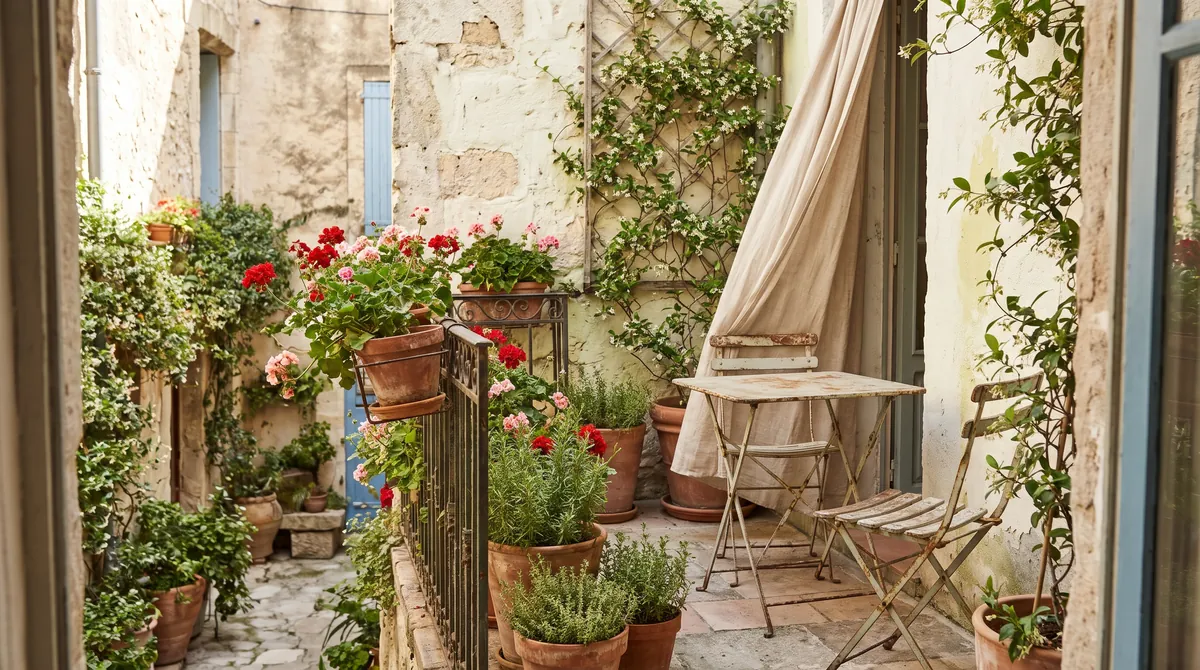
When the floor is small, the walls become the garden. Andalusian patios show how well this works: pots fixed to whitewashed walls at different heights, filled with flowers, turn a plain enclosure into a room full of colour. On a balcony or in a narrow courtyard, a trellis with jasmine adds green and scent while taking only a few centimetres of depth. Wall planters, narrow shelves and planters hung on the inner side of a railing all add growing space without stealing floor.
Fix everything properly. Use brackets and hooks suited to the wall, and check them every spring, because pots of wet soil are heavier than they look and a gust can catch leaves and stems. Keep the lowest level of the wall for pots you can reach easily, and save the highest for tough plants that forgive a missed watering.
Furniture that folds, benches that store
Folding bistro furniture in iron is the classic answer for a balcony: a round table and two chairs that fold flat against the wall when you need the floor for watering or for drying laundry. Iron is heavy enough not to blow over, and its slender lines take up little visual space. Choose pieces with a good protective coating, and touch up chips before rust sets in.
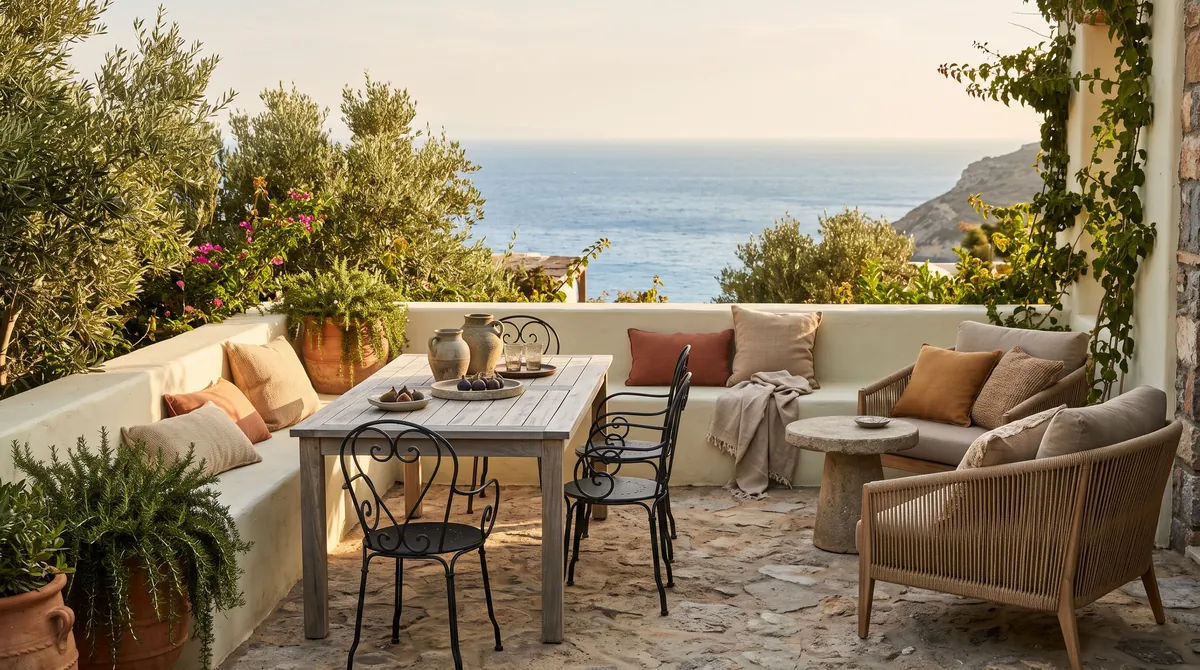
In a courtyard, a built-in bench along one wall does the work of several pieces of furniture. Give it a hinged seat and use the space inside for cushions, tools and bags of potting compost, so that nothing else needs to stand around. A few cushions in linen or outdoor fabric make it comfortable, and they go back inside the bench when it rains.
Light walls, water and scent by the door
Many small courtyards are shaded for most of the day by the buildings around them. Light coloured walls, in a warm white limewash or mineral paint, reflect what light there is and make the space feel larger and brighter. A pale floor helps too, and so do plants with glossy leaves that catch the light.
Sound changes how a small space feels. A small fountain, or simply a wide bowl of water, softens the noise of traffic and voices from the street, and birds soon come to drink. If a pump needs electricity, have an outdoor socket installed by a qualified electrician.
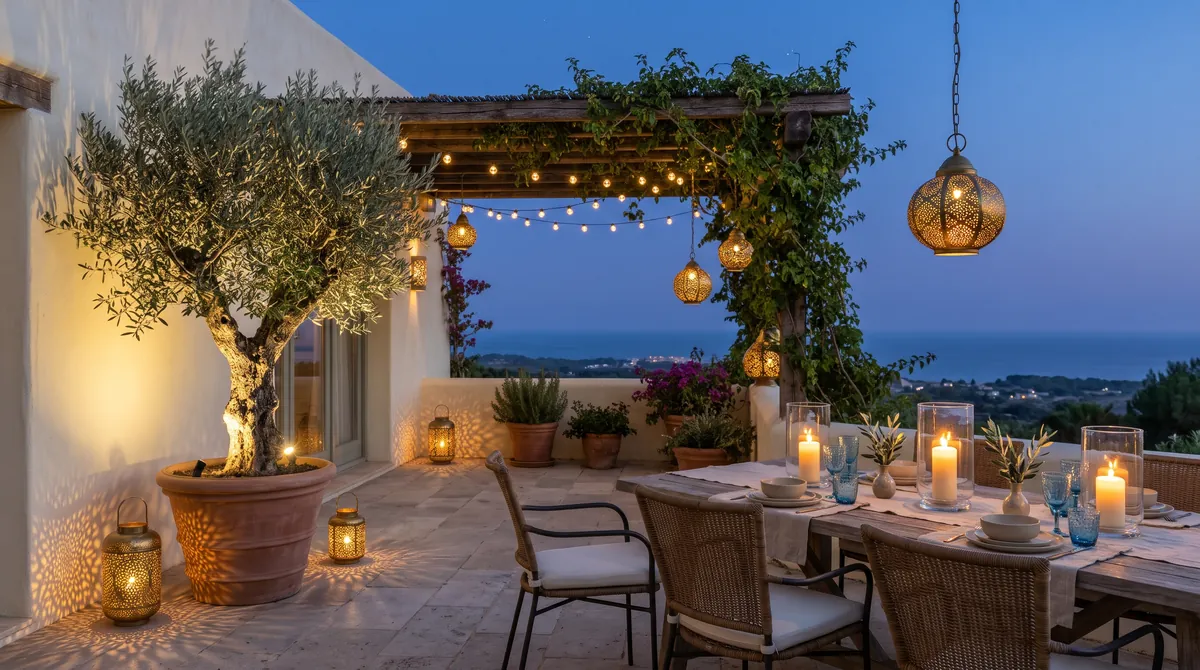
Place scented plants where you pass them: jasmine or a pot of rosemary beside the door, lavender on the sunny edge of the balcony, so that you brush against them on the way in. In the evening, a couple of lanterns or a candle in a glass give all the light a space this size needs.
Plants for shade and for sun
Choose plants for the light you really have, not the light you wish for. Watch your balcony or courtyard through a summer day and note when the direct sun arrives and when it leaves. For shade, these are reliable:
- Ferns for the darkest, coolest corners, where their fronds soften walls and steps.
- Aspidistra, tough and patient in deep shade, with long dark leaves.
- Ivy to green a wall or trail from a shelf.
- Clivia for orange flowers in shade, in a pot that is not too large.
- Hydrangeas for part shade, with generous water in summer.
Where the sun shines for much of the day, the choice turns properly Mediterranean:
- Herbs such as rosemary, thyme, sage and oregano, within reach of the kitchen.
- Lavender for scent and bees on the sunniest railing.
- Pelargoniums, the geraniums of southern balconies, flowering for months.
- Bougainvillea in a large pot against a warm wall, where it can be protected from frost.
Practical points before you start
A balcony is part of a building, and a few practical points protect you, the structure and the people below.
- Load. Every balcony has a limited load capacity. Large planters, wet soil and stone furniture add up quickly, so keep heavy items close to the wall and ask a structural engineer before you add anything substantial.
- Drainage. Keep the balcony drain or spout clear of soil and leaves, and never block the fall of the floor with planters.
- Rules. Read the rules of the building or the community of owners, which may limit what can be fixed to façades and railings.
- Security. Secure every pot so that nothing can fall, especially on railings and ledges and on windy days.
- Drip trays. Put a saucer under every pot so that no water drips onto the neighbours below, and water slowly.
Living outdoors depends far less on space than on how carefully the space is used.
Privacy is the last piece. Cane screens on a balcony railing, or linen curtains hung across a courtyard, filter the view from neighbouring windows without shutting out air and light, and they can be rolled up or drawn back when you want to look out.
Questions and answers
What plants grow on a shady balcony?
Ferns, aspidistra, ivy and clivia cope well with little direct sun, and hydrangeas do well in part shade with regular watering. Keep sun lovers such as herbs and lavender for the brightest spots.
How much weight can a balcony carry?
That depends on the construction and age of the building, so there is no general answer. Keep heavy planters close to the wall and ask a structural engineer before adding anything substantial, such as large stone planters or built-in furniture.
How do I stop water dripping onto the balcony below?
Put a saucer under every pot, water slowly and avoid overfilling. Keep the balcony drain clear so that rainwater runs away where it is meant to.
How can I make a dark courtyard feel brighter?
Paint the walls in a warm white limewash or mineral paint, choose a pale floor and plant shade lovers with glossy leaves. A few lanterns in the evening add warmth without glare.
Further reading in our network
- colistiaIndoor and outdoor living
Indoor and outdoor living, with ideas for balconies, courtyards and small terraces.
- island mallorcaThe island atlas
The island atlas of Mallorca, with its old towns, villages and their quiet courtyards.
Our articles are general information written with care. Building work, roof loads, electrics, gas and fire need qualified professionals and local permits; plant care depends on your own climate and soil.