
Pergolas and shade: vines, reeds and canvas over the terrace
A pergola is only as good as the shade it casts at four in the afternoon. How to place it, build it and cover it, from grape vines to reed mats and canvas.
At about four o’clock on an August afternoon, the light on a terrace changes character. The sun has dropped low enough in the west to slide under any roof, and the stone floor that felt cool at lunch begins to give back its heat. Under a pergola covered with an old grape vine, though, the light arrives green and broken, moving over the table whenever the leaves stir. You hear wasps among the ripening bunches and smell warm wood. The difference between a frame that merely looks shady and one that really is comes down to a handful of decisions.
A roof of leaves, from the Latin pergula
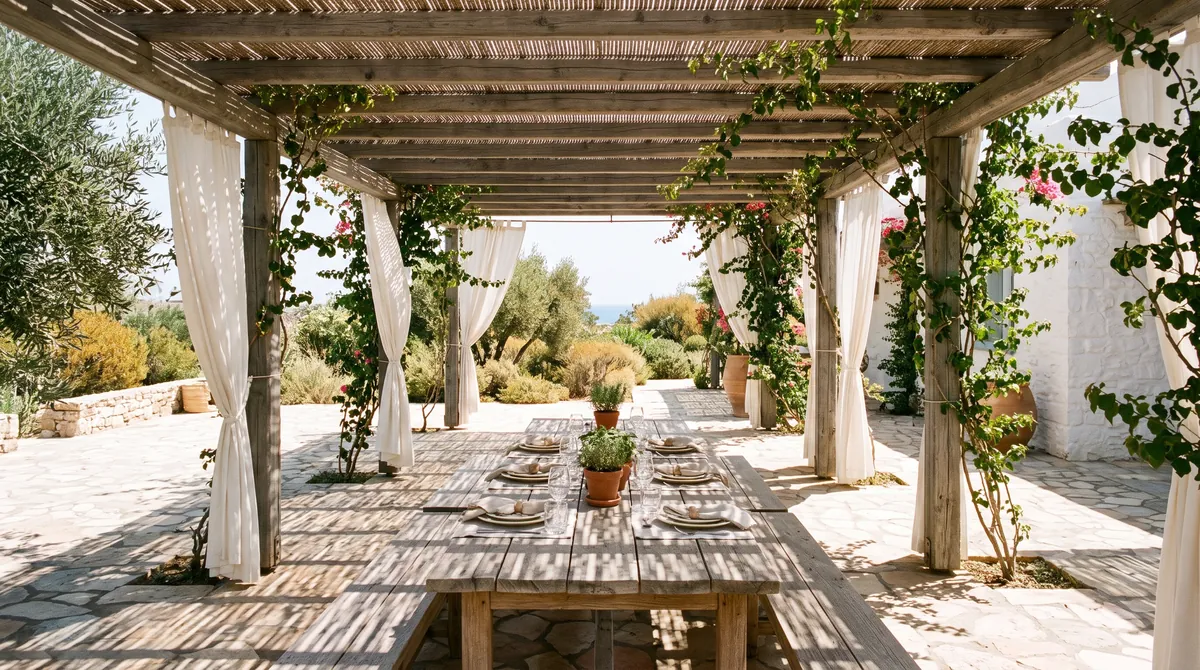
The word comes from the Latin pergula, a projecting roof or arbour, and the idea has barely changed since: a set of posts carrying beams, with something light laid across the top. It is not a building but a frame for shade, which is why it suits the Mediterranean so well. Solid walls store heat and block the breeze; a pergola lets air move freely on every side while taking the sting out of the sun. Treat it as a room with a ceiling but no walls, and plan it as carefully as you would plan any room in the house.
Read the sun before you draw anything
Before you choose a material, watch where the sun falls on your terrace through a whole summer day. South and west sides need the most shade in summer. The midday sun stands high, so a roof over a south-facing terrace deals with it well. The western sun is the real problem: in the late afternoon it drops so low that it slips straight under the roof and lands on your face just as you sit down for an early drink.
That is why a pergola on a west-facing terrace almost always needs something at the side as well as on top. These are the options that work:
- Side screens of reed or slatted timber, fixed or sliding, on the western edge only, so the other sides stay open to the breeze.
- Curtains of heavy linen or outdoor canvas on a rail beneath the beam, drawn in the evening and tied back in the morning.
- Plants trained up the western posts, such as jasmine or a vine, which make a living wall over a season or two.
- A tree planted a few metres beyond the pergola, which catches the low sun before it reaches the frame.
An east-facing terrace has the opposite character: soft morning sun that most people welcome, and natural shade from the house in the afternoon. There a lighter covering is often enough, and you may want it only over the table.
Height, size and room for the chairs
A low pergola looks intimate in a drawing and feels stifling in July. Warm air collects under any roof, and it needs room above your head to move away. A clear height of about 2.4 to 3 m is comfortable for most terraces; towards the upper end the air circulates better and climbing plants can hang down a little without brushing your hair. Go much higher and the shadow falls further from where you sit, so the gain is lost.
For the footprint, start from the table. Measure the dining table you actually own, then add the room needed to pull out a chair and walk behind someone who is seated, usually around 1 m on each side where people sit. A pergola that only just covers the table leaves half your guests in the sun by the time the main course arrives, because the shadow moves with the day.
Timber, steel or stone: choosing the frame
Traditional frames are timber. Chestnut is durable and has long been used for posts and beams in southern Europe; larch is resinous and weathers well; pine is lighter and widely available but needs treatment against rot and insects, especially where posts meet the ground. Raise timber posts on metal shoes or stone bases so that they never stand in water.
Steel and iron give slender profiles and long spans, which suits a modern house or a wide terrace, but they need protection against rust, particularly near the sea. Stone or masonry pillars, often rendered and limewashed, carrying timber beams are the classic farmhouse arrangement: solid, cool to lean against and heavy enough to anchor a big vine. Whatever you choose, the posts must be properly founded, because a pergola covered in leaves or canvas catches the wind like a sail.
What goes on top
The covering decides the quality of the shade far more than the frame does. Each one has its own light, its own sound in the wind and its own amount of work.
| Covering | Shade and light | Upkeep |
|---|---|---|
| Grape vine | Dappled green light; the leaves fall in autumn and let the winter sun through | Pruned every winter; ripe fruit draws wasps in late summer |
| Wisteria | Dense shade once established, scented flowers in spring | Very vigorous, needs a strong frame and pruning in summer and winter |
| Bougainvillea or jasmine | Patchy shade with strong colour or scent | Tie in new growth; bougainvillea needs warmth and frost protection |
| Reed or bamboo mats | Soft, striped light, quick to put up | Replaced every few years as the reeds turn brittle |
| Woven willow | Warm, textured shade with a rustic look | Similar to reed; lasts longer kept out of constant wet |
| Canvas sail or awning | Even shade that can be taken down or rolled away | Take down before storms; wash and store in winter |
| Fixed slats or adjustable louvres | Precise shade; louvres can be angled with the sun | Little care; closed louvres shed rain, fixed slats do not |
Deciduous climbers give shade in summer and let the sun through in winter.
Deciduous plants are the cleverest choice in a climate with hot summers and cool winters. A grape vine or a wisteria shades the terrace exactly when you need it and drops its leaves just when you want the low winter sun to warm the floor and the rooms behind it.
In Spain the reed mat laid across a frame is called cañizo, and it is still one of the simplest ways to make shade in a single weekend. Fix the mats with wire to battens rather than directly to the beams, so that you can replace them later without dismantling anything.
Shade sails: tension, slope and fixings
A sail is lighter and quicker to install than a pergola, but it only works if it is set up properly. Three things matter most.
- Tension. A slack sail flaps, wears quickly and sags into a bag that holds water. Tensioning hardware at each corner lets you tighten it evenly.
- Slope. Set one or two corners clearly lower than the others so that rain runs off instead of pooling. A twisted shape sheds water well and looks livelier too.
- Fixings. The wind pulls hard on a sail. Fix the corners to sound masonry, a properly founded post or a structural beam, never to a gutter, a drainpipe or a thin wall.
Take sails down before a storm, and in winter if you do not need them; the fabric lasts much longer that way, and so do the fixings.
The western sun is the real problem: it slips straight under the roof just as you sit down for an early drink.
Rules, care and the long view
Pergolas, fixed roofs and even sails are treated differently from place to place, and a frame attached to the house or built close to a boundary may need permission or have to keep a distance from the neighbour’s land. Check the local building rules before you order timber, and in a flat or shared building read the rules of the community of owners as well.
Once it is up, the routine is simple. Prune vines in winter while they are dormant, cutting each spur back to one or two buds. Check bolts and ties every spring. Expect to replace reed mats every few years, and oil or treat timber when it starts to look dry and grey at the ends. Given that attention, a well-made pergola grows more beautiful each year as the plants thicken and the shade deepens.
Questions and answers
Which climbing plant gives the best shade on a pergola?
A grape vine gives light, dappled shade and loses its leaves in winter, which suits most terraces. Wisteria gives denser shade and scented flowers but is very vigorous and needs a strong frame. Bougainvillea and jasmine add colour and scent, but their shade is patchier.
How long do reed mats last?
Reed or bamboo mats usually last a few seasons before sun and rain make them brittle. Fixing them to battens rather than straight onto the beams makes replacing them quick and easy.
Do I need permission to build a pergola?
That depends on where you live, on the size of the structure and on whether it is attached to the house. Check the local building rules first, and in an apartment building the rules of the community of owners as well.
Why does my shade sail collect water?
A sail without enough slope or tension sags and holds rain. Lower one or two corners and tighten the fittings evenly so that water runs off the edge.
Further reading in our network
- colistiaIndoor and outdoor living
Ideas for indoor and outdoor living, from terrace furniture to the rooms that open onto it.
- sunalivSolar and smart living
Solar and smart living, with ways to use the sun’s energy and keep a house cool in summer.
Our articles are general information written with care. Building work, roof loads, electrics, gas and fire need qualified professionals and local permits; plant care depends on your own climate and soil.