
The Andalusian patio: water, tiles and pots on white walls
Open to the sky and closed to the street, the Andalusian patio is a room built around shade and the sound of water. What makes it work, and how to borrow the idea for a small courtyard.
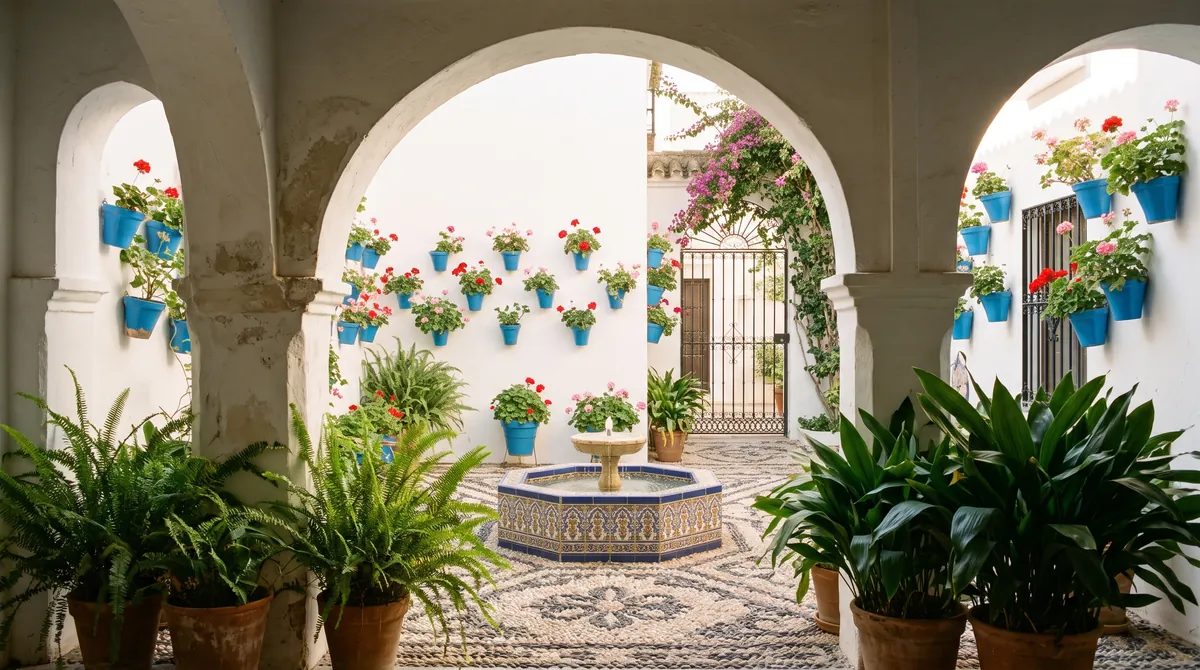
Step in from a white street in Córdoba at noon and the air seems to cool with the first stride. The light, so hard outside, softens on whitewashed walls hung with dozens of pots. Somewhere in the middle, water falls into a stone basin with a sound that is barely more than a murmur, and the air smells of damp earth, jasmine and the green of ferns. Above you hangs a square of blue sky. Nothing in the patio is grand, yet every element is there for a reason, and most of those reasons have to do with heat.
A house turned inwards
The courtyard house has deep roots. They lie in the Roman house, with its atrium and its colonnaded peristyle, and in the architecture of al-Andalus, which refined the idea of a garden enclosed by rooms. The principle is simple: the house turns its back on the dust, noise and glare of the street and opens instead onto a space of its own, open to the sky, around which the rooms are arranged.
In this arrangement the patio is not an extra. It is the centre of the house: the place where light enters, where cool air collects at night, where the family sits in the evening and where the plants are tended. The rooms around it borrow its shade and its breeze, and in summer much of daily life moves out into it, from the first coffee to the last conversation of the night.
Water at the centre
Almost every patio has water, usually a fountain or a low basin in the middle. Its first gift is sound. A thin jet falling into a basin masks the noise of the town and gives the space a calm rhythm, which is why the best fountains are modest: a trickle, not a roar. The second gift is cooling. As water evaporates from the basin and from wet stone, it takes heat from the air, and in a sheltered courtyard where the air is still, you can feel the difference on your skin.
Historic examples show how far the idea can be taken. The courtyards of the Alhambra in Granada carry water through the buildings in long pools and narrow channels, and the Real Alcázar in Seville combines fountains, tiled walls and planted courts. At home the same effect can come from a single stone bowl, a wall fountain or a basin no larger than a dining chair.
Tiles, cobbles and white walls
The surfaces of a patio are chosen to stay cool and to be washed down easily. Floors are often made of cobbles or river pebbles laid in patterns, sometimes in black and white, sometimes in simple borders that circle the fountain. They drain well, they look beautiful when wet and they give a little texture underfoot, which matters on a floor that is regularly splashed.
Walls are whitewashed, which reflects the light and keeps the masonry cooler, and they are frequently given a dado, a bench or a fountain surround of glazed tiles called azulejos. The word comes from Arabic and is usually explained as ‘small polished stone’, a fitting name for a glossy tile that catches the light at the edge of the shade. Blue, green and ochre patterns against white lime belong to the visual language of the patio.
Windows onto the street carry wrought iron grilles, the rejas, and the entrance often has an iron gate behind the heavy main door. When that door stands open, passers-by can look through the gate into the patio: a glimpse of green, flowers and water that the owners seem happy to share with the street.
Pots on the walls, plants in the shade
The most recognisable feature is the wall of flowers: dozens of pots, often painted blue, hung on nails or brackets up the whitewashed walls and filled with geraniums and other flowering plants. On the ground stand citrus trees in large pots, jasmine climbs a column, and in the deepest shade ferns and aspidistras grow in their own cool corner.
- Geraniums (pelargoniums) for the upper walls, where the sun reaches for part of the day and they flower through the warm months.
- Citrus trees in large pots for scent, glossy leaves and fruit.
- Jasmine on a column or trellis beside a seat, where its evening scent is strongest.
- Ferns and aspidistras in the shady lower part of the patio, where few flowering plants thrive.
Watering a pot that hangs 3 m up a wall is a craft of its own. Residents traditionally use a watering can fixed to the end of a long cane, lifting it and tipping it carefully into each pot from the ground. It is slow, quiet work, done in the cool of the morning or evening, and it is as much part of the patio as the fountain.
Córdoba in May
In Córdoba many private patios open to visitors every May, and the old town fills with people walking from one courtyard to the next. The owners prepare for months, and the result shows how much variety fits within a few simple rules: whitewash, water, pots and shade. The Fiesta of the Patios in Córdoba was inscribed on the UNESCO Representative List of the Intangible Cultural Heritage of Humanity in 2012, a recognition that the patio is not only architecture but a living tradition of care, shared between neighbours.
The best fountains are modest: a trickle, not a roar.
Creating the patio feeling in a small courtyard
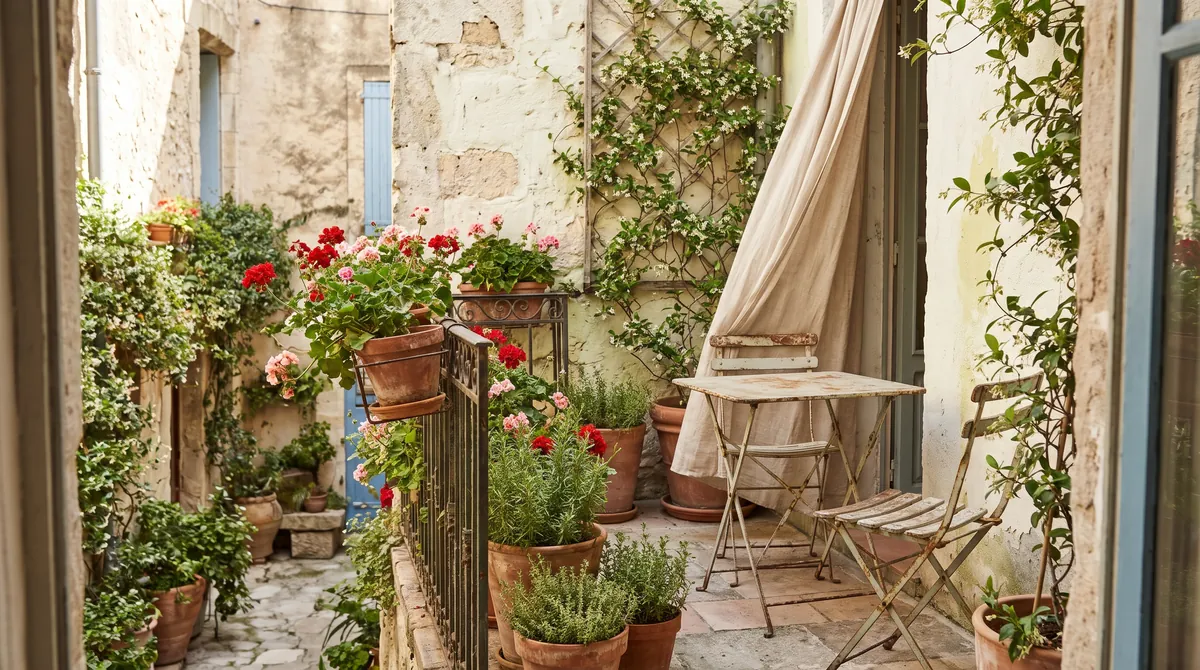
You do not need a historic house to borrow the idea. A small courtyard, a light well or a walled corner of a garden can take on the same character if you work with its enclosure rather than against it.
- Whiten the walls. Limewash or a mineral paint in a warm white brightens a shaded space and makes pots and leaves stand out against it.
- Add the sound of water. A wall fountain or a bowl with a small recirculating pump is enough; have any outdoor socket and cable installed by a qualified electrician.
- Go vertical. Fix pots to the walls at different heights with strong hooks or brackets, and paint them all in one colour to tie the wall together.
- Keep the floor simple. Pebbles, terracotta or stone that drain freely and can be washed down on hot evenings.
- Plant for the light you have. Flowers high up where the sun reaches, ferns and aspidistras low down in the shade.
- Frame a view. An iron gate or grille instead of a solid door lets the courtyard be glimpsed and gives it depth.
Washing down the floor on a summer evening is worth adopting too. Wet stone and pebbles cool as the water evaporates, the dust settles and the plants smell stronger, and it is the moment when a patio feels most like itself.
Finally, use it. A patio comes alive when it is part of every day, for a morning coffee or for watering the pots at dusk, and over the seasons the plants and the people grow into it together.
Questions and answers
What plants grow well in a shady patio?
Ferns and aspidistras are the classic choice for the deepest shade, and ivy and clivia also cope well. Keep flowering plants such as geraniums for the upper walls, where the sun reaches for a few hours a day.
How do people water pots high on the walls?
Traditionally with a watering can fixed to the end of a long cane, tipped into each pot from the ground. It takes a little practice, and it is best done in the cool of the morning or evening.
Does a fountain really cool a courtyard?
In a sheltered space it can make a noticeable difference, because evaporating water takes heat from the air and wet stone stays cool. The sound of water also makes a space feel calmer and fresher.
When can you visit the patios of Córdoba?
Many private patios in Córdoba open to visitors every May. Going early in the day is usually more pleasant, when the light is soft and the heat has not yet built up.
Further reading in our network
- andaluisTravel and sights in Andalusia
Travel and sights in Andalusia, from the old town of Córdoba to the palaces of Granada and Seville.
- tifaniaBeautiful places to stay
Boutique hotels and beautiful places to stay, for travellers who love old houses and quiet courtyards.
Our articles are general information written with care. Building work, roof loads, electrics, gas and fire need qualified professionals and local permits; plant care depends on your own climate and soil.