
The Mediterranean interior: light, texture and restraint
From Andalusia to the Greek islands, Mediterranean houses share thick lime walls, cool floors and controlled light. How the style works, and how to bring it home without pastiche.
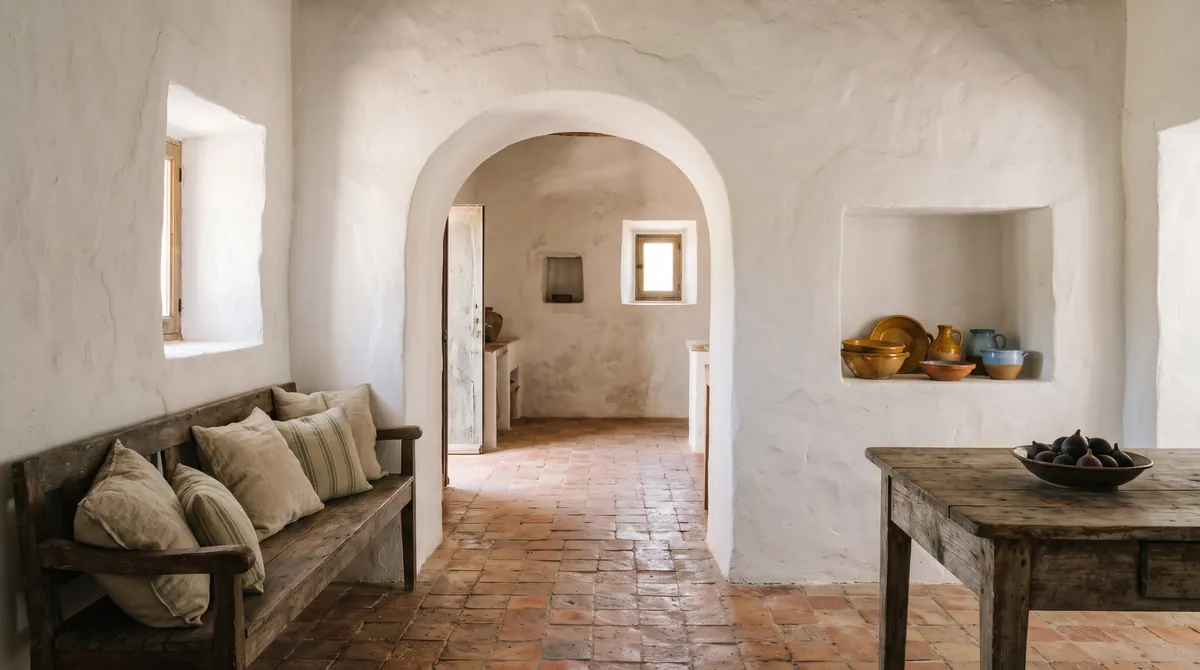
Step in from a white lane at noon and your eyes need a moment. The room is dim and quiet, the walls are half a metre deep, and slats of light from the shutters lie across a terracotta floor that feels cool under bare feet. There is a scrubbed table, a rush-seated chair, a row of glazed bowls on a shelf set into the wall. Nothing is there for show. The air smells faintly of lime and beeswax, and the heat outside seems very far away.
A style that begins with the walls
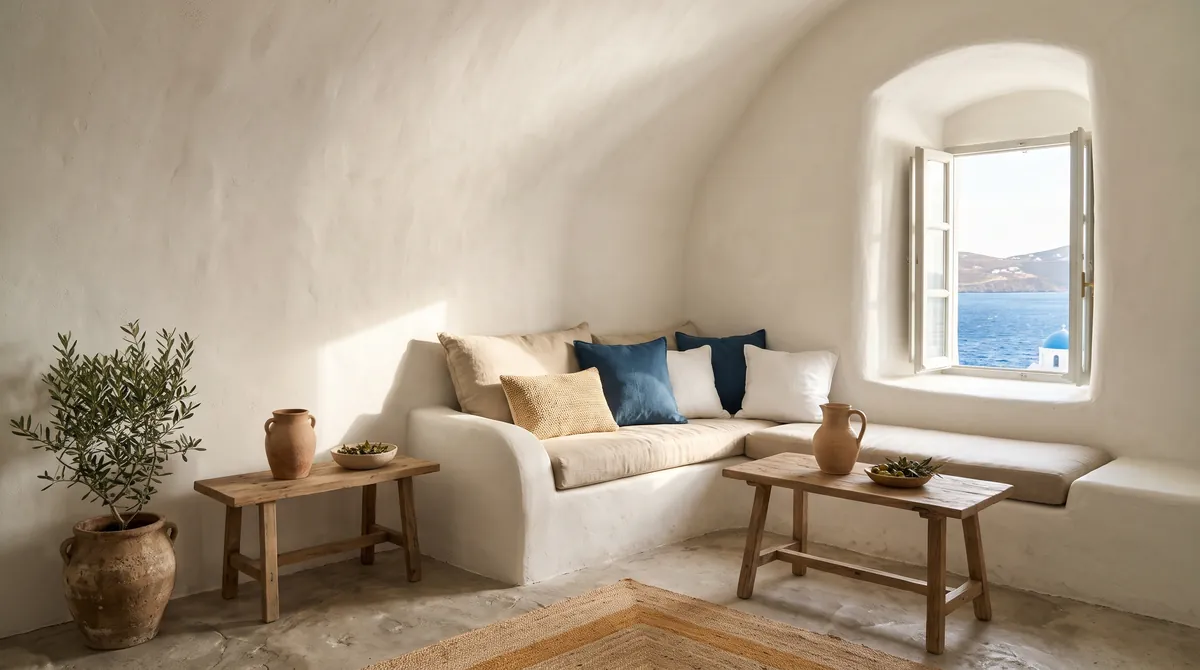
What links a farmhouse in Provence with a village house on a Greek island is not a catalogue of objects but a way of building. Walls are thick masonry of stone, rubble, brick or earth, often half a metre or more, finished with lime plaster that is smoothed by hand and never perfectly flat. Those walls do the work that insulation and air conditioning do elsewhere: they slow the heat of the day and give it back gently at night. They also give the rooms their character. Corners are softened, window reveals are deep enough to sit in, and the plaster catches the light in a way that paint on board never will.
Windows follow the same logic. On the sunny sides they are small and set deep in the wall, so the sun strikes the reveal rather than the room. Wooden shutters close them during the hottest hours: persianas in Spain, volets in France, persiane in Italy. The result is a house that is lived in half light for much of the summer, which is why Mediterranean rooms feel calm rather than bright. Light is something you let in deliberately, a slice at a time, and the shutters are as much a part of the interior as any piece of furniture.
Floors that stay cool underfoot
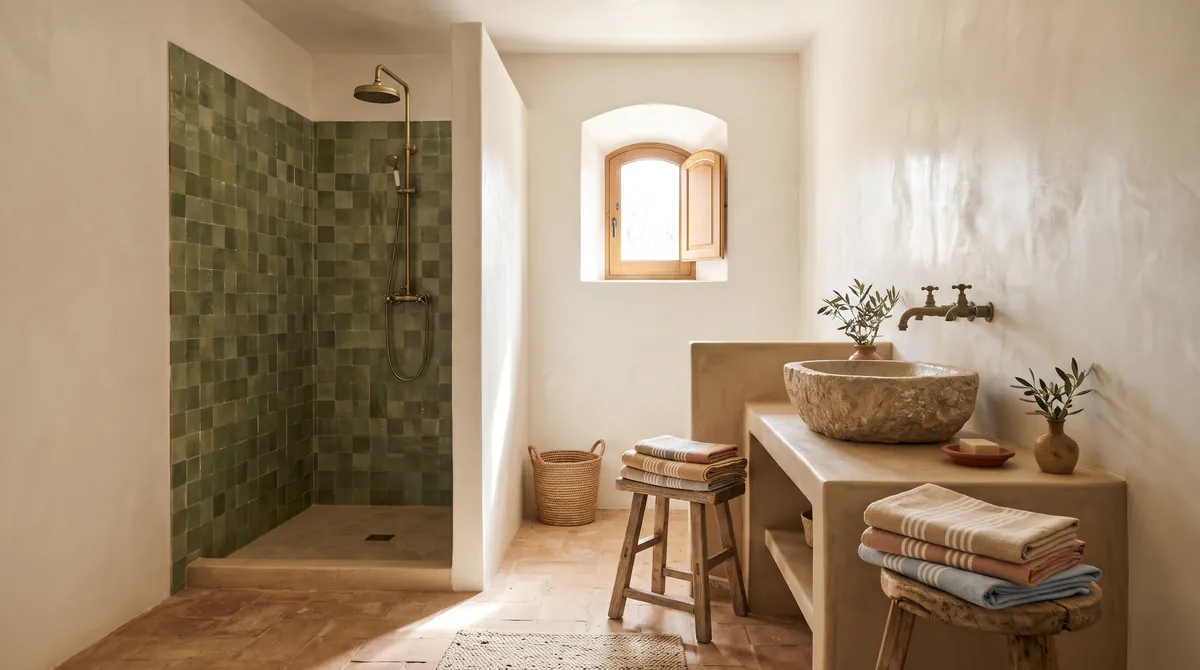
The floor is the other half of the frame. Terracotta, cement tiles and stone all stay cool in summer and age without fuss. Terracotta is warm in colour and slightly porous, so it darkens and gains a soft sheen with years of waxing and use. Cement tiles, with their pressed patterns, bring colour into a hallway or a kitchen without any further decoration. Stone, whether a pale limestone or a local sandstone, gives the most solid feel of all. None of them tries to be uniform: small variations in tone are part of the appeal, and a floor that shows its wear usually looks better than a new one.
Built in, not bought in
Many of the most typical pieces of a Mediterranean room were never furniture at all. Niches cut into thick walls hold lamps, books or a jug of flowers. Benches run along a wall and are plastered in with it. Arches divide rooms without closing them off. Because so much is built in, the furniture that remains can be sparse: a few solid pieces in wood, iron and rush, chosen for use and kept for decades. The shared grammar, wherever you are on the coast, looks roughly like this.
- Walls: lime plaster or limewash in white or earthy mineral colours, with a hand-finished surface.
- Floors: terracotta, cement tiles or stone, bare in summer and softened with a rug in winter.
- Furniture: few but solid pieces, such as a long table, rush-seated chairs, an iron bed, a painted chest.
- Textiles: linen and cotton in plain weaves, stripes or simple prints, never glossy synthetics.
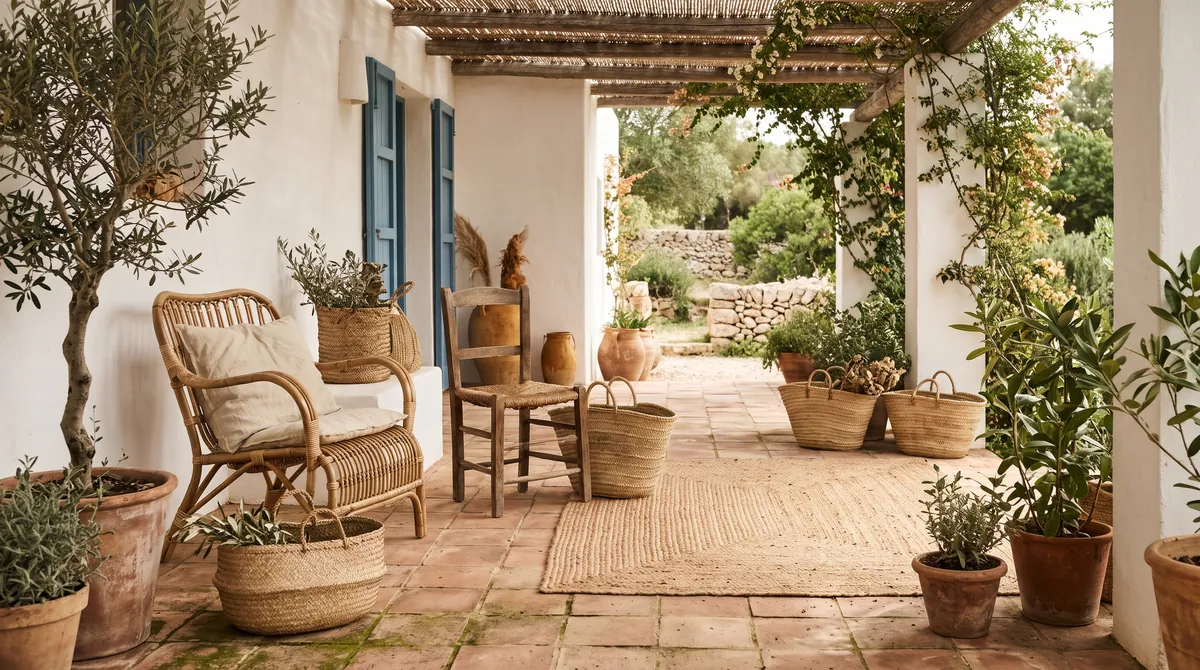
- Objects: ceramics on open shelves, baskets, a bowl of fruit, plants in clay pots.
Colour stays close to the earth. Whitewash is the default in the hottest places, because it reflects the sun and is easy to renew, but ochre, sand, sienna and soft clay pinks appear wherever local pigments were at hand. Mineral colours like these have depth because light passes into the surface and back out again, rather than bouncing off a plastic film. That is why a limewashed wall seems to change through the day, cool and pale in the morning, warm and almost golden in the evening.
Regional accents from Provence to Morocco
Within that shared grammar every region speaks with its own accent. Knowing the differences helps you choose one direction instead of mixing all of them into a generic ‘Mediterranean’ look that belongs nowhere.
| Region | Walls and colour | Typical details |
|---|---|---|
| Provence | Ochre and warm earth façades, soft whites inside | Painted wooden furniture, printed cottons, lavender in bunches and bowls |
| Andalusia | Brilliant whitewash | Glazed tiles called azulejos, wrought iron window grilles called rejas, inner courtyards |
| Greek islands | White cubic houses | Blue doors and shutters, sofas and beds built in plaster |
| Tuscany | Stone, terracotta and warm sienna tones | Heavy timber beams, terracotta floors |
| Mallorca | Golden marès sandstone | Green louvred shutters, exposed beams |
| Moroccan influence | Polished tadelakt plaster | Geometric zellige tiles in deep glazes |
Most houses mix influences; the table shows tendencies, not rules.
Bringing the feeling into any home
You do not need thick walls or a southern sky to borrow the essence. The method is the same everywhere, and it starts with taking things away rather than adding them.
- Reduce. Clear surfaces and walls first. A Mediterranean room relies on a few good things with space around them.
- Change the walls. Limewash and other mineral paints give the soft, uneven depth that ordinary emulsions lack. Check that the surface and primer suit the paint you choose.
- Choose natural materials. Solid wood, iron, rush, linen, cotton, clay and stone age well and feel right to the touch.
- Control the light. Shutters, louvred blinds or linen curtains let you shape daylight rather than simply letting it flood in.
- Add plants and ceramics. A bay tree in a clay pot by a bright window, glazed bowls on an open shelf, a jug used as a vase.
A Mediterranean room is shaped less by what you put into it than by what you leave out.
Avoiding pastiche under a northern sky
The most common mistake is to copy the motifs and forget the light. Under a cooler northern sky, the brilliant white that glows in Andalusia can look grey and flat, and blue shutters on a brick terrace in a rainy town rarely convince. The light is softer and bluer, so warm whites with a touch of ochre or grey, and surfaces with real texture, matter far more than any copied detail. A lime-plastered wall, a waxed terracotta floor or a rough linen curtain carries the feeling on its own.
Be wary, too, of themed decoration: plates hung as souvenirs, imitation wrought iron, printed tiles pretending to be handmade. They point at a style without having its substance. Better one honest material used generously than a dozen references to somewhere else.
Time does the rest. Natural materials improve with use, and a room built on them grows better rather than more tired as the years pass. That quality, more than any blue door, is the part of the Mediterranean house most worth bringing home.
Questions and answers
Can I create a Mediterranean interior in a modern flat?
Yes. Start by reducing, then change the walls to a mineral paint, bring in natural materials such as linen, wood and clay, and use blinds or curtains to shape the light. The feeling comes from materials and restraint, not from the age of the building.
Which white works best in a north-facing room?
Usually a warm white with a little ochre, sand or grey in it. Brilliant whites tend to look cold and flat in cool light. Test large samples in the room for several days before you decide.
Do I need real terracotta or stone floors?
They help, but they are not essential. A pale, matt wooden floor with a flat-woven cotton or jute rug can carry the same calm. If you lay terracotta in an area that connects to the outside, choose frost-resistant tiles.
How do I avoid a themed look?
Pick one regional direction and keep to its materials and colours, avoid imitation materials and souvenir decoration, and leave space empty. One genuine piece, such as an old table or a handmade bowl, does more than many references.
Further reading in our network
- MurosoArchitecture and interiors
Architecture and interiors, with houses and rooms explored through their materials and the way they are built.
- diseliaDesign, interiors and objects
Design, interiors and objects, from furniture and ceramics to the details that give a room its character.
Our articles are general information written with care. Building work, roof loads, electrics, gas and fire need qualified professionals and local permits; plant care depends on your own climate and soil.