
Bathrooms in stone and lime: tadelakt, tiles and terracotta
Polished lime, handmade tiles and natural stone give a bathroom the calm of a hammam. What each material asks of you, how to care for it and why ventilation matters most.
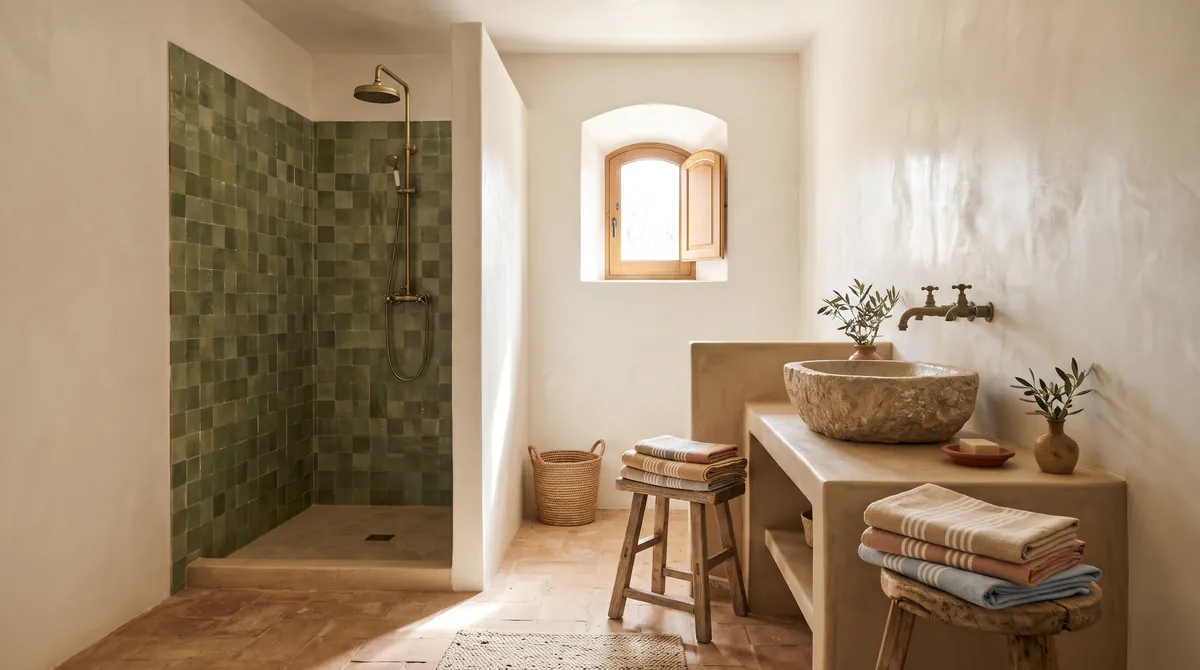
In the evening, with only a small lamp lit, the walls of the shower seem to glow. The plaster curves from wall to floor without a single joint, smooth as a river pebble and faintly warm in colour. Water runs off it in beads. There is a brass tap gone soft and brown with age, a wooden stool, a folded striped towel, and the faint, clean smell of olive soap. It feels less like a bathroom than a small hammam, a room made for slowing down.
Tadelakt, the polished lime of Morocco
Tadelakt is a Moroccan lime plaster, traditionally from the region of Marrakech, and it has long been used in hammams and bathrooms. It is applied in layers, then compacted and polished with smooth stones until the surface becomes dense and softly lustrous. Finally it is treated with black olive oil soap, savon noir, which reacts with the lime and makes the surface water resistant.
The result is seamless. Tadelakt can wrap around a shower niche, a bench or a basin without a single tile joint, and its soft sheen has the depth of a material worked by hand rather than coated. That is also its demand: it needs skilled hands. Applying, compacting and polishing must happen at the right moment as the lime sets, and mistakes are hard to correct afterwards. It is a job for an experienced plasterer, not a weekend project.
Living with tadelakt
Treated well, tadelakt lasts and improves with age. The rules are few but strict.
- Clean with mild soap and water, ideally the same olive oil soap used in the finish.
- Never use acidic cleaners such as vinegar, citric acid or limescale removers. Acid attacks lime and dulls or damages the surface.
- Wipe the shower walls down after use in hard water areas, so that limescale does not build up.
- Accept small marks and variations in tone; they are part of a hand-polished surface.
Lime in its wet state is caustic. If you work with it yourself, even for small repairs, wear gloves and eye protection and follow the instructions that come with the material.
Tiles, terracotta, stone and cement
Tadelakt is not the only way to bring Mediterranean character into a bathroom. Tiles and stone have been used in wet rooms around the sea for just as long, and each behaves differently.
Handmade glazed tiles and zellige, the small, irregular glazed tiles of Morocco, are superb in showers: the glaze sheds water and the uneven faces catch the light. The joints are the weak point. They need careful grouting and sealing, and then regular attention. Terracotta brings warmth underfoot but is porous, so in wet areas it must be sealed. Natural stone is the most varied group: marble and limestone are sensitive to acids, including many bathroom cleaners, while travertine has natural pores that are often filled before it is laid. Cement tiles, with their pressed patterns, need sealing too.
| Material | Character | In the wet zone | Care |
|---|---|---|---|
| Tadelakt | Seamless, soft sheen, hand-polished lime | Showers and walls, applied by skilled hands | Mild soap only, refreshed with soap, never acids |
| Zellige and handmade tiles | Glazed, irregular, rich in colour | Excellent in showers | Seal the joints and check them regularly |
| Terracotta | Warm, earthy, porous | Floors, only when sealed | Renew the sealer when water stops beading |
| Marble and limestone | Cool, elegant, sensitive to acids | Floors and walls, with care | Neutral cleaners, never acidic ones |
| Travertine | Warm, with natural pores | Floors and walls, pores usually filled | Neutral cleaners, keep the pores filled |
| Cement tiles | Patterned, matt, porous | Floors and walls, once sealed | Seal before use, clean with mild products |
Sealers differ for stone, terracotta and cement; ask whoever lays the floor which one suits your material.
Why lime and bathrooms get along
Lime has a good reputation in wet rooms for a reason. Lime surfaces are vapour permeable, so moisture can move in and out of the wall instead of being trapped behind a sealed layer. They are also strongly alkaline, which discourages mould. A lime-plastered wall outside the splash zone, finished with limewash, suits a bathroom far better than a plastic paint that traps damp behind it.
None of this replaces airing the room, though. Lime helps a bathroom cope with moisture, but it cannot make steam disappear on its own.
Fixtures and the small things
The fittings should be as simple as the surfaces. A walk-in shower without a tray or door, with the floor laid to a gentle fall towards the drain, suits tadelakt and tiles alike and makes a small bathroom feel larger. A basin of stone or ceramic, set on a plastered shelf or an old piece of furniture, replaces the usual vanity unit.
Brass taps develop a patina over the years, turning from bright gold to a soft brown, and are best left to do so. A wooden stool serves as a seat, a shelf and a place for a towel. And flat-woven cotton fouta towels, known from Tunisia, are a practical pleasure: light, thin and quick drying, they take up little space and dry in a damp room far faster than thick towels.
A good Mediterranean bathroom is built from very few materials, each chosen because it gets along with water.
Ventilation comes first
Whatever you choose, good ventilation is essential. Steam that has nowhere to go condenses on cool walls and in joints, and even the most forgiving lime surface will suffer if the room stays damp for hours every day.
- Open the window wide for a few minutes after every shower, rather than leaving it tilted all day.
- Where there is no window, fit an extractor fan, ideally one that keeps running for a while after the light is switched off. Have it installed by a qualified electrician.
- Leave the door open after bathing so that moisture can spread out and dry.
- Hang towels to dry outside the bathroom where you can.
Questions and answers
Is tadelakt really waterproof?
It is water resistant rather than a sealed membrane. Compacting, polishing and the reaction with olive oil soap make the surface shed water, which is why it has long been used in hammams. It needs gentle care with mild soap and must never be cleaned with acids.
Can I use marble in a shower?
Yes, but marble and limestone are sensitive to acids, including many bathroom cleaners and limescale removers. Use neutral cleaners, wipe the stone dry after use and accept that it will develop a patina.
Does terracotta work on a bathroom floor?
It does, as long as it is sealed, because untreated terracotta is porous and absorbs water and soap. Renew the sealer when water stops beading on the surface.
What are fouta towels?
Flat-woven cotton towels known from Tunisia. They are light and thin, dry very quickly and take up little space, which makes them practical in a humid bathroom and on the beach.
Further reading in our network
- diseliaDesign, interiors and objects
Design, interiors and objects, from basins and taps to the details of a well-made room.
- MurosoArchitecture and interiors
Architecture and interiors, with a close look at lime, stone and the traditional ways of building with them.
Our articles are general information written with care. Building work, roof loads, electrics, gas and fire need qualified professionals and local permits; plant care depends on your own climate and soil.