
Cycladic style: whitewash, blue and built-in furniture
On the islands of the Aegean, wind, sun and scarce water shaped white cubic houses with built-in plaster furniture. What lies behind the look, and how to bring its calm into your own home.
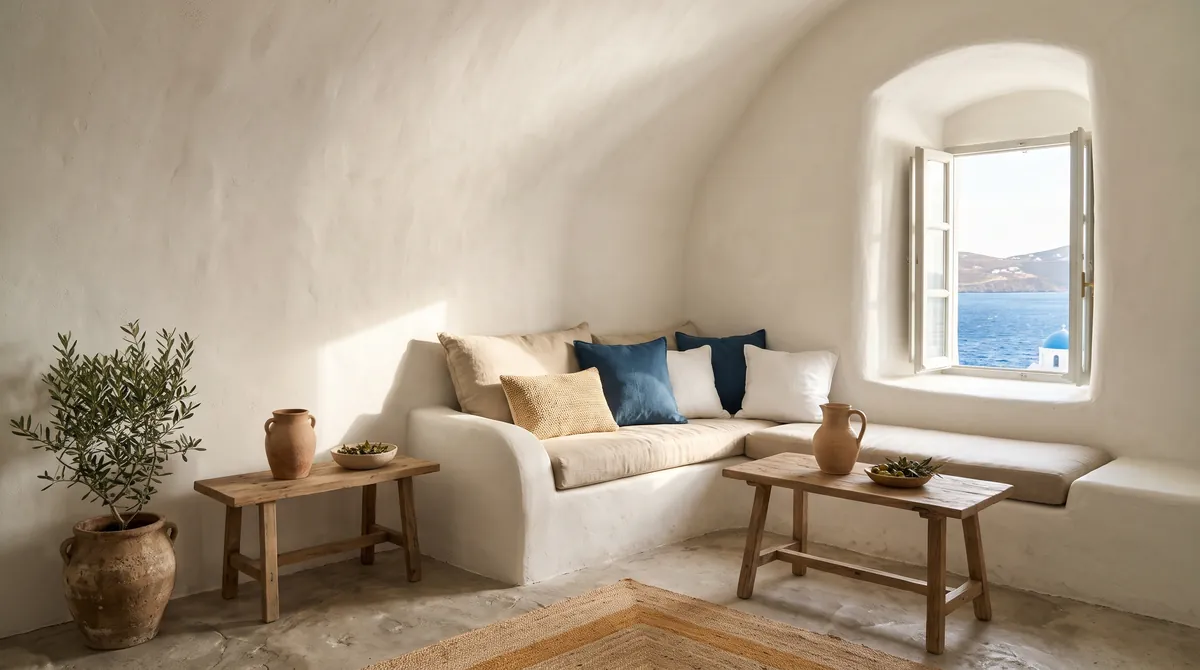
The lane is barely wider than your outstretched arms, and the walls on either side are so white in the noon sun that you half close your eyes. A blue door, a pot of basil on a step, a cat asleep in a strip of shade. Then a gust of wind comes down the lane, dry and strong, tugging at your shirt. You step through a low doorway and everything changes: the room is cool, rounded and quiet, with a white plaster bench along one wall and the sea showing as a blue square in a deep window.
Islands that built against wind and sun
The Cyclades are an island group in the Aegean Sea, among them Santorini, Mykonos, Paros, Naxos, Sifnos and Folegandros. Their traditional architecture grew out of scarcity: little timber, little water, strong sun and strong wind. The answer was the cubic house, built of thick stone walls coated with lime and whitewashed, with small windows and a flat roof.
Every part had a purpose. The flat roofs were also used to collect rainwater, on islands where every drop counted. The thick walls kept the rooms cool by day, and the small windows let in enough light without letting in the heat. The villages themselves were built tight, with narrow lanes that give shade for much of the day and break the force of the wind. On Santorini some houses go further still: cave houses dug into the volcanic rock, where the earth around them keeps the rooms at an even temperature.
The meaning of whitewash
The white of the islands is not paint in the modern sense but lime. Whitewashing with lime was traditionally renewed regularly, often before Easter, when steps and lanes were freshened along with the walls. Lime also has a cleansing effect, which made the whitewash a matter of hygiene as well as appearance. And white reflects the sun, keeping walls and roofs cooler than any darker colour could.
The constant renewal also explains the soft, rounded look of the houses. Layer upon layer of lime fills corners and smooths edges until the buildings seem moulded rather than built. It is a quality worth copying: crisp, sharp edges feel modern, while rounded ones feel unmistakably of the islands.
Blue doors and white domes
Against all that white, blue stands out. Doors, shutters and window frames painted in deep or faded blues, and church domes in the same colour, created the blue and white image of the islands that so many people carry in their minds. Seen on a sunny lane, the combination is calm rather than loud, because the white dominates and the blue appears only in small, deliberate doses.
It is the proportion that matters. A Cycladic room is overwhelmingly white, with blue as an accent on a door, a shutter or a cushion. Turn the ratio around and the effect quickly becomes theatrical.
Furniture made of the house itself
Inside, the defining feature is furniture that is part of the building. Sofas and beds rest on raised platforms of plaster, built in along the walls and rounded at the edges. Niches cut into the walls serve as shelves and bedside tables. Arches span between rooms, and wooden beams cross the ceilings, often the only dark element in an otherwise white space. Textiles are simple and woven: a striped cushion, a flat rug, a cotton throw over a plaster bench.
This approach saves space in small houses and leaves almost nothing to clutter the floor. It also explains why the rooms feel so calm: there are very few separate objects for the eye to catch on, and the light falls on smooth, continuous surfaces that seem to flow from floor to wall to ceiling.
Living with the meltemi
In summer the meltemi, a strong, dry northerly wind, blows across the Aegean, mostly in July and August. It brings relief from the heat, but it also shapes the way people live. Terraces and seating corners are best placed in the lee of the house, out of the wind. Outdoor furniture is heavy or built in, awnings are kept low or rolled away on windy days, and cushions and fabrics are tied or weighed down. Doors and shutters must close firmly and be hooked back when open, because a sudden gust will slam anything left loose.
The island palette
The colours of the Cyclades are few, and all of them come from the landscape around the houses.
- White: the lime of the walls, for all the largest surfaces.
- Aegean blue: doors, shutters, a single cushion or a painted chair.
- Bougainvillea: a vivid magenta that appears in flowers rather than on walls.
- Sand: natural linen, rope, rush seats and woven baskets.
- Stone grey: paving, rough walls and the bare stone of terraces.
On the islands the house itself is the furniture, and white is less a colour than a habit, renewed with lime.
Bringing the island home
You can borrow the Cycladic calm without a single blue dome. It is mostly about reduction and soft forms.
- Paint with lime. Limewash or lime paint gives the soft, slightly cloudy white that ordinary emulsion cannot match.
- Round the edges. Ask your plasterer to soften corners, window reveals and the edges of niches.
- Build a bench. A built-in bench along a wall, on a masonry or timber base finished in plaster, with long cushions on top, gives seating and storage in one.
- Keep decoration minimal. A few ceramics, a woven basket, a bunch of dried grasses.
- Add blue sparingly. One door, a pair of shutters or a few textiles are enough.
Ceramics complete the picture: simple bowls and jugs, glazed or plain, standing in niches or on a plaster shelf. Under a northern sky choose a slightly warmer white than you would on the islands, so that the room glows rather than looking cold.
Questions and answers
Why are the houses in the Cyclades white?
They are whitewashed with lime, which reflects the strong sun and keeps the walls cooler. Lime also has a cleansing effect, and the whitewash was traditionally renewed regularly, often before Easter.
What is the meltemi?
A strong, dry northerly wind that blows across the Aegean in summer, mostly in July and August. It cools the islands but calls for sheltered terraces, heavy outdoor furniture and doors and shutters that close firmly.
Can I build plaster furniture in a flat?
Often yes, using a light timber or block base finished with plaster. Check the load the floor can carry and any rules for your building first, and ask a qualified builder for advice before you start.
How much blue should I use?
Less than you think. Cycladic rooms are mainly white, with blue on a door, a pair of shutters or a few cushions. Too much blue quickly looks like a theme rather than a home.
Further reading in our network
- tifaniaBeautiful places to stay
Boutique hotels and beautiful places to stay, including whitewashed island houses where you can live this style for a while.
- MurosoArchitecture and interiors
Architecture and interiors, with the island building traditions of the Aegean and their materials explained.
Our articles are general information written with care. Building work, roof loads, electrics, gas and fire need qualified professionals and local permits; plant care depends on your own climate and soil.