
An olive tree of your own: in the garden and in pots
Few trees carry as much history as the olive, and few are as easy to live with. What it asks for is sun, sharp drainage, a careful winter and a light hand when pruning.
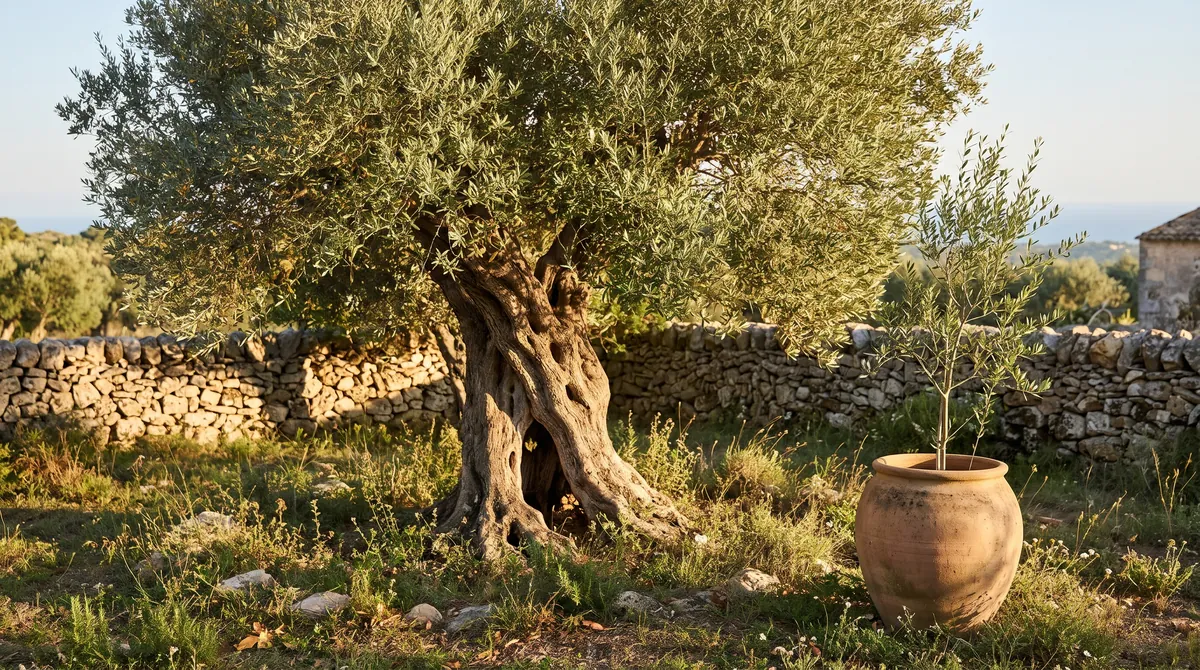
Stand under an old olive on a windy afternoon and the whole crown seems to shiver between two colours. The upper sides of the leaves are a dull grey-green, the undersides almost silver, and every gust turns them over so that the tree flickers like water. The trunk below does not move at all. It twists, splits and folds back into itself, hollow in places, polished smooth where generations of hands have leaned on it. An olive does not hurry, and owning one, even a young one in a pot, teaches you a little of its patience.
A tree with a long memory
Olea europaea has been cultivated around the Mediterranean for thousands of years, and it shapes the landscape from Andalusia to the Greek islands. Individual trees can live for many centuries. As they age, the trunk develops its famous hollows and twists, opening and dividing while the living wood keeps growing around the gaps. The tree is evergreen, so its silver grey canopy gives a garden structure all year, and it casts a light, dappled shade rather than the heavy darkness of a fig or a carob.
The flowers are easy to miss: small, creamy white and fragrant, they appear in late spring in loose clusters among the leaves and are pollinated by the wind rather than by insects. The olives ripen through autumn and winter, turning from green to violet and black. Picked straight from the branch they are intensely bitter, and they must be cured in water, brine or salt before anyone will want to eat them.
Sun, drainage and very little else
In the ground an olive asks for very little. Give it the sunniest place you have and soil that drains quickly. It copes with poor, stony ground and, once established, with long summer droughts. What it will not tolerate is waterlogging. On heavy clay, plant on a low mound or improve a wide area with coarse grit, because a planting hole dug into clay simply fills with water like a sump.
Young trees are sensitive to hard frost, while mature trees tolerate light frosts without harm. Inland gardens where winter nights fall well below freezing are therefore a gamble for the first few years. Plant in spring where winters are cold, so that the tree has a full season to settle, and in autumn where they are mild. Water deeply every week or two through the first summer, then gradually less. An olive that has been in the ground for a few years needs no watering in most Mediterranean summers, although a good soaking during a very long drought helps the fruit to swell.
Olives in pots
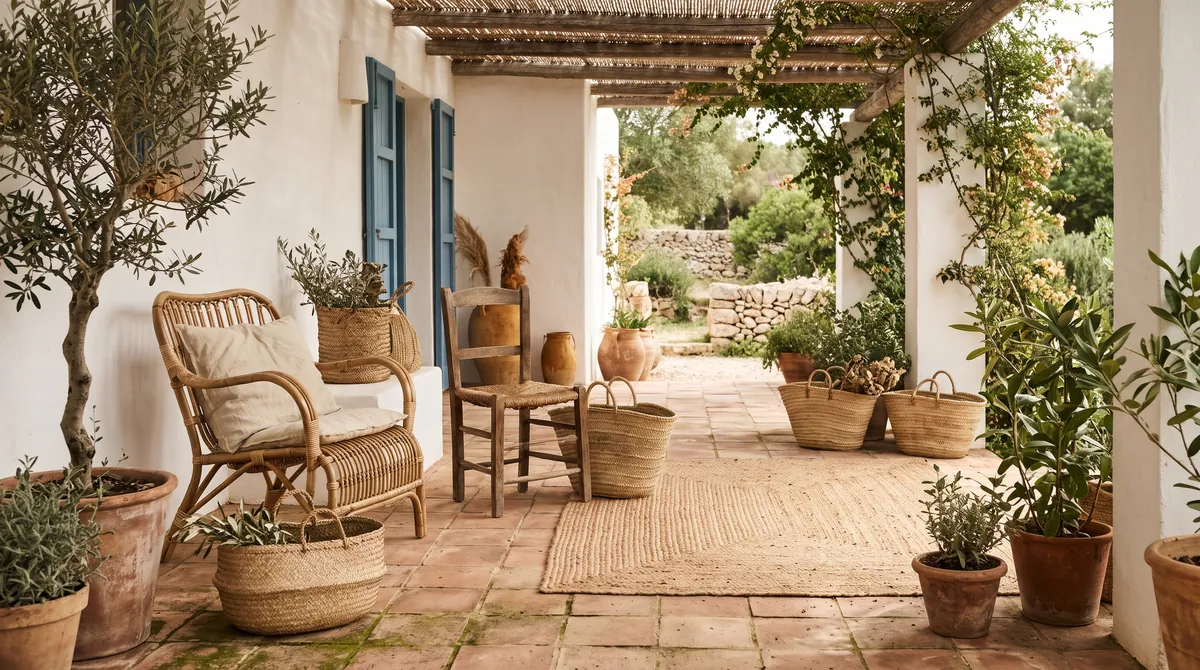
An olive in a large pot is one of the most rewarding plants for a terrace or balcony, and the only way to grow one where winters are hard. Here the pot matters as much as the tree. It should be large, heavy enough not to blow over, and have generous drainage holes. Terracotta breathes and keeps the roots cooler in summer, but it dries out faster than glazed or stone containers.
- Choose a container a little wider than the root ball rather than a vast one, and move up a size every few years.
- Cover the drainage holes with a few pieces of broken pot so that the soil does not wash out.
- Fill with a gritty, free-draining mix: good potting soil with roughly a third of grit or pumice.
- Set the tree at the same depth as before, firm gently and water until it runs from the base.
- Stand the pot on feet so that water never collects underneath it.
Water when the top few centimetres of soil feel dry, which in summer may mean every two or three days and in winter only every few weeks. Never leave the pot standing in a saucer of water. Feed lightly in spring with a general fertiliser for pot plants, and replace the top layer of soil with fresh mix once a year.
Winter in colder climates
Where frosts are hard and long, an olive in a pot spends the winter under cover, but not in the living room. It wants a bright, cool, frost free place: an unheated conservatory, a stairwell with large windows, a light garage or a greenhouse. In a warm, dark room it drops its leaves and weakens. Bring it in late, when the first real frosts are forecast, and take it out again early, once the hard frosts are over, so that it spends as much of the year as possible in fresh air. In milder places, a pot against a south-facing wall, wrapped in fleece on the coldest nights, is often enough.
Pruning: room for a bird to fly through
Olives are pruned in late winter or early spring, once the worst of the cold is past and before new growth starts. The aim is an open, goblet-shaped crown that lets light and air into the centre. Growers like to say that a bird should be able to fly through the middle of a well pruned tree. Light reaching the inner branches keeps them leafy and fruitful, and moving air dries the leaves after rain, which helps to keep fungal problems away.
Start by removing anything dead or damaged, then the shoots that grow straight up from the main branches or sprout from the base of the trunk, and the branches that cross or crowd the centre. Cut back to a side branch or to the trunk, never leaving stubs. Take out a few larger branches rather than trimming the whole crown like a hedge, which only produces a thicket of soft shoots. A pot-grown tree follows the same principles in miniature, and a light trim in summer keeps its shape compact.
An olive does not hurry, and owning one teaches you a little of its patience.
Choosing a tree with a clear conscience
Ancient olives with gnarled trunks are sometimes dug out of old groves and sold as instant character for new gardens. Many struggle after the move, having lost most of their roots, and their removal strips the countryside of trees that have stood for generations. Choose a nursery grown tree instead. A young tree with a straight stem and a well branched crown settles quickly, and within some years it begins to look as if it has always been there. Look for healthy, evenly coloured leaves, no swellings or cracks on the stems, and roots that fill the pot without circling it in thick coils.
A symbol of peace and wisdom
No tree in the Mediterranean carries more meaning. Since antiquity the olive branch has stood for peace, and the tree itself for wisdom. In ancient Greece it was the tree of Athena, goddess of wisdom, who in the old myth gave the olive to the city that came to bear her name. Planting one, even in a pot by the front door, connects a modern garden to that long story, and it is a tree that may well outlive everyone who plants it.
Questions and answers
Can I eat the olives from my own tree?
Yes, but not straight from the branch, where they are very bitter. They need curing first, usually by soaking them in water that is changed regularly and then keeping them in brine. It takes patience, often a few weeks or more.
Why is my potted olive dropping leaves?
The most common causes are too much water, a pot standing in a saucer, or a winter spent in a warm, dark room. Check that the soil drains freely and that the tree has plenty of light. A sudden move from indoors into full sun can also cause some leaf drop, so get it used to the outdoors gradually in spring.
How big a pot does an olive need?
Start with a container a little wider than the root ball and move up a size every few years. A mature tree is happiest in a pot of about 60 cm across or more, heavy enough to stay upright in the wind.
Will my olive tree produce fruit?
Many olives set some fruit, but flowering depends on plenty of sun, a cool spell in winter and the age of the tree. Young trees and trees grown in shade often flower little. Treat the fruit as a bonus rather than the reason to plant one.
Further reading in our network
- island mallorcaThe island atlas
The island atlas of Mallorca, with its villages, coastlines and the terraced landscapes of the mountains.
- andaluisTravel and sights in Andalusia
Travel and sights in Andalusia, from the white towns to the great cities and the olive country inland.
Our articles are general information written with care. Building work, roof loads, electrics, gas and fire need qualified professionals and local permits; plant care depends on your own climate and soil.