
Bougainvillea, jasmine and other climbers for warm walls
A sunny wall is the warmest place in any garden. How to clothe it with bougainvillea, scented jasmine, wisteria or a vine, and how to give each climber the support it needs.
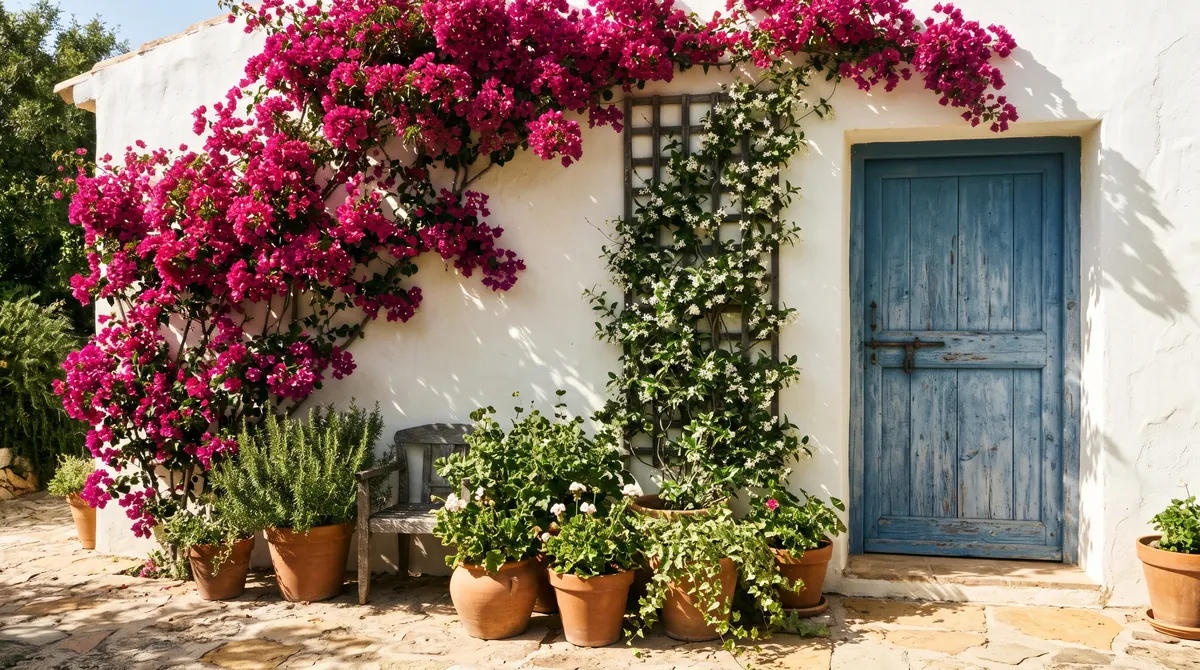
By early afternoon a south-facing wall in a Mediterranean village gives back the heat like an open oven door. Bougainvillea loves it. Against the white lime the bracts glow magenta, orange or soft pink, and the papery colour drifts down onto the cobbles below. A few steps further along, a star jasmine over a doorway scents the whole lane at dusk. Climbers are the quickest way to soften stone and bring shade and scent to a house, but each one climbs in its own way, and the right support matters as much as the right plant.
How climbers climb
Before choosing a plant, look at how it holds on, because that decides the kind of support it needs:
- Twiners, such as wisteria and the jasmines, wrap their stems around wires, poles or trellis.
- Tendril climbers, like the grape vine, grip with thin curling tendrils and need something slim to hold.
- Scramblers, including bougainvillea and climbing roses, simply lean on other plants and structures and hook over them with their thorns, so they must be tied in.
- Self-clingers, such as the trumpet vine, hold onto a wall or a tree directly with small aerial roots.
Bougainvillea: colour from the bracts
Bougainvillea comes from South America. It is named after the French navigator Louis Antoine de Bougainville, whose expedition in the eighteenth century brought the plant to European attention. What looks like the flower is in fact a set of bracts, modified leaves in vivid colours, wrapped around small white or cream flowers that you only notice up close. Because the bracts last much longer than the flowers, a plant can stay in colour for weeks.
It needs sun and warmth above all. Plant it against the hottest wall you have, in well drained soil, and be sparing with water once it is established: bougainvillea flowers best when it is kept a little dry, while generous watering and feeding produce long leafy shoots and few bracts. It must be protected from frost. In mild coastal gardens it can grow into a great cascade over a wall; in colder climates it is a plant for a large pot that moves to a bright, frost free place for winter.
Because it scrambles rather than twines, bougainvillea will not climb a wall on its own. Tie the main stems to wires or a trellis with soft ties and keep tying in as it grows, guiding shoots sideways so that flowers form along their length. Wear gloves, since the stems carry sharp thorns. Prune after a flush of flowers, shortening the flowered shoots to keep the plant compact and encourage the next flush, or prune more firmly in late winter before growth begins.
Scented climbers: star jasmine and common jasmine
For scent, few climbers match the jasmines. Star jasmine, Trachelospermum jasminoides, is evergreen, with glossy dark leaves and white, starry flowers in early summer that smell sweetest in the evening. It grows in sun or part shade, is hardier than bougainvillea and makes a neat cover for a fence, a trellis panel by the front door or the posts of a pergola. Common jasmine, Jasminum officinale, is lighter and looser, a twiner with fine leaves and clusters of white flowers in summer, ideal over an arch or along a balcony rail where you pass it often.
Shade overhead: vine and wisteria
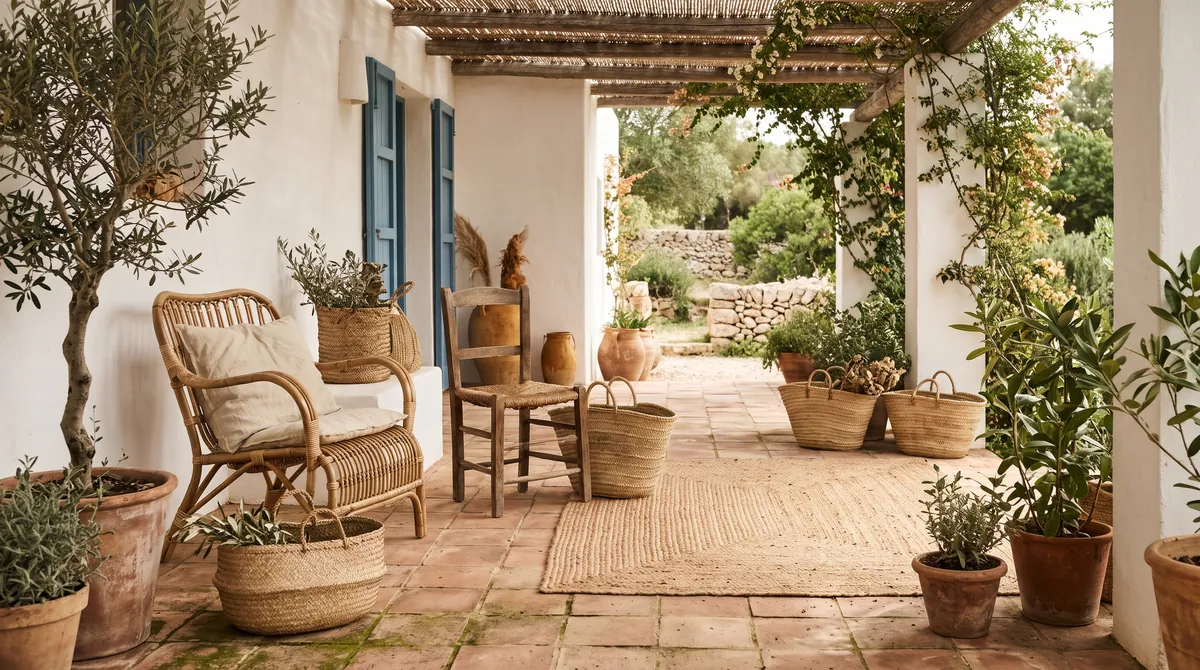
A pergola covered in leaves is one of the oldest ways of keeping a Mediterranean terrace cool, shading it in summer and letting the sun through in winter once the leaves have fallen. The grape vine is the classic choice: it grows quickly, holds on with its tendrils and gives a dappled green light, and with luck bunches of grapes hanging overhead.
Wisteria is the grander option, with long hanging clusters of flowers in spring and a heavy, twisting trunk with age. It is also very vigorous, and its stems tighten around anything they wrap, so it needs a strong, solid pergola or heavy wires fixed firmly into the wall. It is pruned twice a year. In summer, cut the long, whippy shoots back to five or six leaves; in winter, shorten the same shoots again to two or three buds. This keeps the plant in check and encourages flower buds to form.
Blue, orange and old roses
Plumbago brings a colour that is rare among climbers: soft sky blue flowers through the warm months. It is tender and loose in habit, more a leaning shrub than a true climber, so tie it to a trellis or let it tumble over a low wall. The trumpet vine, Campsis, is the opposite: tough and very vigorous, with orange trumpet flowers in summer. Give it room and keep it well away from the roof. Climbing roses have their place too, especially on old stone walls, where they look as if they have always been there. They like their heads in the sun but shade at their roots, so plant something low in front of the base or lay a few flat stones over the soil to keep it cool.
| Climber | How it climbs | Light | Frost | Pruning |
|---|---|---|---|---|
| Bougainvillea | Scrambles, must be tied in | Full sun, warm wall | Must be protected | After a flush of flowers or in late winter |
| Star jasmine, Trachelospermum jasminoides | Twines | Sun or part shade | Hardier | Light trim after flowering |
| Common jasmine, Jasminum officinale | Twines | Sun | Fairly hardy | Thin out after flowering |
| Grape vine | Tendrils | Full sun | Hardy | In winter, while the vine is dormant |
| Wisteria | Twines, very vigorous | Sun | Hardy | Twice a year, in summer and winter |
| Plumbago | Leans and sprawls, must be tied | Full sun | Tender | Cut back in late winter |
| Trumpet vine, Campsis | Clings with aerial roots | Full sun | Hardy | Back to a framework in late winter |
| Climbing roses | Scramble, must be tied in | Sun, roots in shade | Hardy | Late winter, tying in new shoots |
Hardiness is a guide: young plants and plants in pots need more protection than established ones in the ground.
Supports, and what to keep clear
Most climbers on a wall need help. Galvanised or stainless steel wires, stretched horizontally about 30 to 40 cm apart and held a few centimetres away from the wall on vine eyes, let air move behind the plant and stop the wall from staying damp. Trellis panels suit lighter climbers such as jasmine; a timber or iron pergola suits a vine or wisteria. Whatever you build, make it stronger than you think you need, because a mature climber in wind and rain is a heavy load. For a large pergola or anything fixed to a roof terrace, ask a qualified professional about loads and fixings.
Plan for maintenance from the start, too:
- Keep climbers away from gutters, downpipes and roof tiles, where shoots can lift tiles and block the flow of water.
- Leave a clear margin around windows and shutters, so that they still open.
- Choose supports you can reach safely with a ladder for pruning and tying in.
- On rendered or painted walls, use wires or trellis rather than self-clinging climbers, which can mark the surface.
Each climber holds on in its own way, and the right support matters as much as the right plant.
Questions and answers
Why does my bougainvillea have lots of leaves but little colour?
Usually because it is too comfortable. Generous watering, rich feeding and too little sun all push leafy growth instead of bracts. Move a potted plant to the sunniest spot you have, water less, and prune after each flush to encourage new flowering shoots.
Can bougainvillea survive the winter outdoors in a cooler climate?
Not where there is regular frost. There, grow it in a large pot and move it to a bright, frost free place for the winter, watering only a little. It may drop some leaves, but it grows back in spring.
Which climber is best for a wall in part shade?
Of the plants here, star jasmine copes best with part shade and still flowers and scents well. Bougainvillea, plumbago and the trumpet vine need full sun to flower and belong on the warmest walls.
Will wisteria damage my house?
It can, if it is planted against the walls and left to itself. Its stems thicken and tighten around anything they grow through, including downpipes, and shoots can push under roof tiles. Grow it on a strong, separate support and prune it twice a year to keep it under control.
Further reading in our network
- colistiaIndoor and outdoor living
Indoor and outdoor living, with ideas for pergolas, shaded terraces and the walls around them.
- tifaniaBeautiful places to stay
Boutique hotels and beautiful places to stay, for travellers who notice the courtyards and gardens as much as the rooms.
Our articles are general information written with care. Building work, roof loads, electrics, gas and fire need qualified professionals and local permits; plant care depends on your own climate and soil.