
Lavender: the right kind, the right place and the right cut
True lavender, lavandin, French lavender: they look alike but behave quite differently. How to choose, where to plant, and the one pruning mistake to avoid.
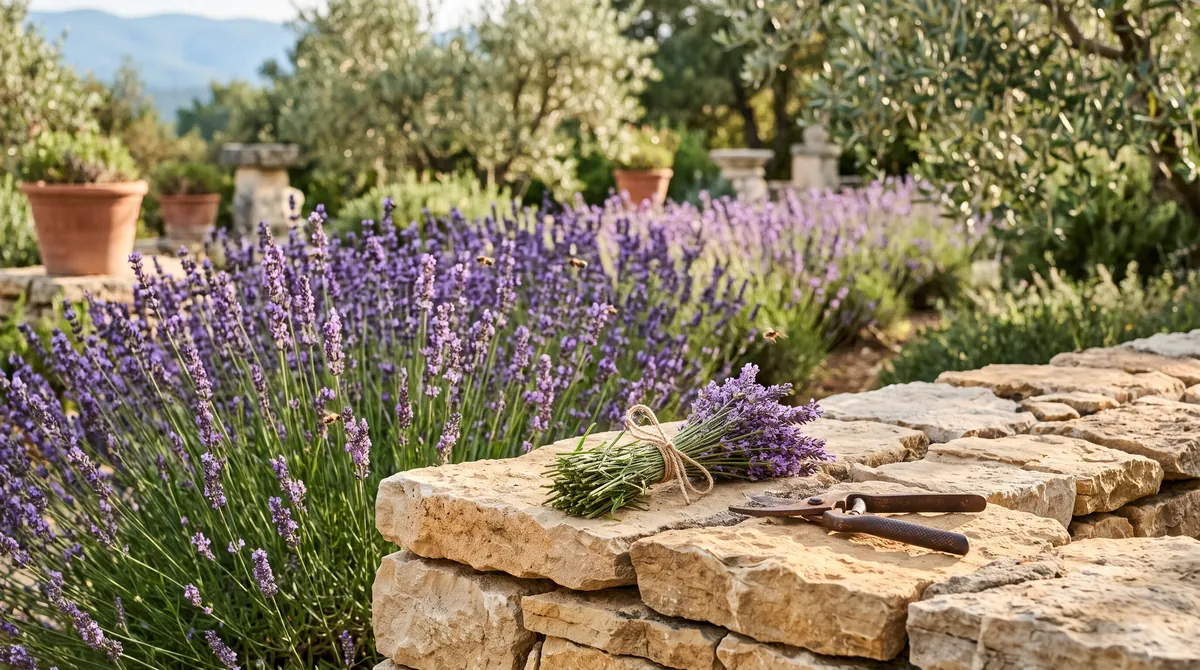
Run your hand along a lavender hedge on a June evening and the scent stays on your skin long after you have walked on. The stems are warm, the flower spikes are busy with bees, and the grey leaves rustle faintly under your palm. On the Valensole plateau in Provence the same scent hangs over whole landscapes in early summer, rows of violet running towards the horizon. Most of us grow a few plants rather than a few fields, but the rules are the same, and they are simpler than many gardeners think.
Four kinds, four characters
Lavender is not one plant but a whole genus, and the kinds you are likely to meet differ in size, hardiness and scent. Knowing which one you have explains most of its behaviour, from when it flowers to how it copes with a cold winter.
| Kind | Character | Flowering | Hardiness |
|---|---|---|---|
| Lavandula angustifolia, true or English lavender | Compact, very fragrant, fine grey leaves; the kind for low hedges and the kitchen | Early to midsummer | The hardiest, survives cold winters in well drained soil |
| Lavandula × intermedia, lavandin | A larger hybrid with long stems and big, strongly scented spikes; grown widely in the fields of Provence | Midsummer, a little after true lavender | Fairly hardy |
| Lavandula stoechas, French or Spanish lavender | Short, plump flower heads topped with petal-like bracts that stand up like little ears | Early, from spring | Less hardy, dislikes long, hard frost |
| Lavandula dentata | Leaves with finely toothed edges and a soft, bushy habit | Over a long season in mild climates | Tender, best in pots where winters are cold |
Within each kind there are many garden forms, with flowers from white and pink to deep violet.
For a cold or wet garden, true lavender is the safe choice. Lavandin makes a bigger, looser plant with a sharper, more camphor-like scent, ideal for the back of a border or a wide edging along a drive. French lavender, with its jaunty bracts, flowers early and is perfect for pots on a warm terrace, but it may not survive a hard winter in the ground away from the coast.
Sun, lean soil and air
Lavender grows wild on dry, stony hillsides, and it wants the same in a garden: full sun for most of the day, poor soil that drains very quickly, and a neutral or alkaline pH. Rich compost, manure and generous feeding are its enemies. They produce lush, floppy growth with less scent, and plants that split open in the middle after a few years. On heavy soil, plant on a mound, in a raised bed or along the top of a dry stone wall, or mix in plenty of grit.
Give each plant space. Lavender likes air moving around its stems, which dries the foliage after rain and keeps rot away. For a hedge, set true lavender about 30 to 40 cm apart and lavandin a little wider, so that the plants just touch when mature rather than crowding each other.
Planting and the first year
Plant in spring or autumn. Spring is safer in cold, wet climates, autumn better in the warm south, where the winter rain helps roots to grow. Water the plant in its pot first, set it at the same depth as before, never deeper, and firm the soil gently around it. Water regularly until it is growing well, then reduce. After the first summer, established lavender in the ground needs little or no watering; plants in pots need more, but the compost should always dry out between waterings. A mulch of gravel rather than bark keeps the base of the plant dry and reflects warmth up into the leaves.
Pruning: the one rule that matters
Most lavender that looks tired and leggy has either never been pruned or has been pruned once too hard. The rule is simple: cut green, never bare. Lavender rarely sprouts again from old, brown, leafless wood, so a plant cut back into it may never recover.
- After flowering, in late summer, cut off all the flower stems and take a little of the leafy growth with them, roughly 2 to 3 cm into the green.
- Shape as you go: aim for a rounded dome, so that rain and snow run off instead of splitting the plant open.
- Always leave green shoots on every branch. If you can see bare wood, you have gone too far.
- In spring, once new growth appears, give a light trim to tidy any shoots damaged over winter.
Even well pruned plants grow woody with age. After some years, when the centre is bare and the shape has gone, it is kinder to replace a plant than to try to rescue it. Lavender is easy to raise from cuttings taken in summer, so a new generation can be ready before the old one fades.
Cut green, never bare: lavender rarely forgives a cut into old wood.
Harvesting and drying
For drying, cut the stems when the first flowers on the spike have just opened, not when the whole head is in full bloom: colour and scent hold better that way. Choose a dry morning, once the dew has gone but before the midday heat. Tie the stems in small bunches and hang them upside down in a dry, shaded, airy place, because sunlight fades the colour quickly. After a week or two the flowers rub easily from the stems and can be stored in a closed jar or tin.
In the house, the kitchen and the garden
Dried flowers fill sachets for drawers and wardrobes, where they keep their scent for months. In the kitchen, use only true lavender, Lavandula angustifolia, and use it sparingly: a few flowers in sugar, shortbread, a honey glaze or a summer syrup are enough, while too much tastes of soap. Lavandin and the other kinds have a harsher, more camphor-like scent and are better kept for the linen cupboard.
Lastly, leave some flowers on the plants. Bees love lavender, and on a warm day a single hedge can hum with them from morning to evening. It is one more reason to plant it near a terrace or a bench, where you can sit in the warmth and listen.
Questions and answers
Why has my lavender gone woody and bare in the middle?
Either it has not been pruned each year, or it is simply old. Lavender becomes woody after some years, and because it rarely regrows from bare wood, a hard cut will not rescue it. Take cuttings in summer and replace the plant.
Can I grow lavender in a pot?
Yes, and it suits French lavender and Lavandula dentata especially well, since a pot can be moved to shelter in winter. Use a gritty compost, a pot with good drainage holes and a sunny spot, and let the compost dry out between waterings.
When do the lavender fields of Provence flower?
On the Valensole plateau the fields flower in early summer, often from late June into July. The exact timing shifts a little with the weather of each year.
Is it too late to prune lavender in autumn?
A light tidy is fine, but avoid cutting hard in autumn in cold climates, as fresh cuts and soft new growth are easily damaged by frost. If you missed the late summer prune, wait until new growth appears in spring and trim lightly then.
Further reading in our network
- tifaniaBeautiful places to stay
Boutique hotels and beautiful places to stay, from country houses inland to small hotels by the sea.
- sunalivSolar and smart living
Solar and smart living, with ideas for using the same sun that ripens your lavender to power the house.
Our articles are general information written with care. Building work, roof loads, electrics, gas and fire need qualified professionals and local permits; plant care depends on your own climate and soil.