
Zellige: the hand-cut glazed tiles of Morocco
Small pieces of glazed clay, cut by hand into stars and polygons: what makes zellige so alive in the light, and how to use it at home without losing its character.
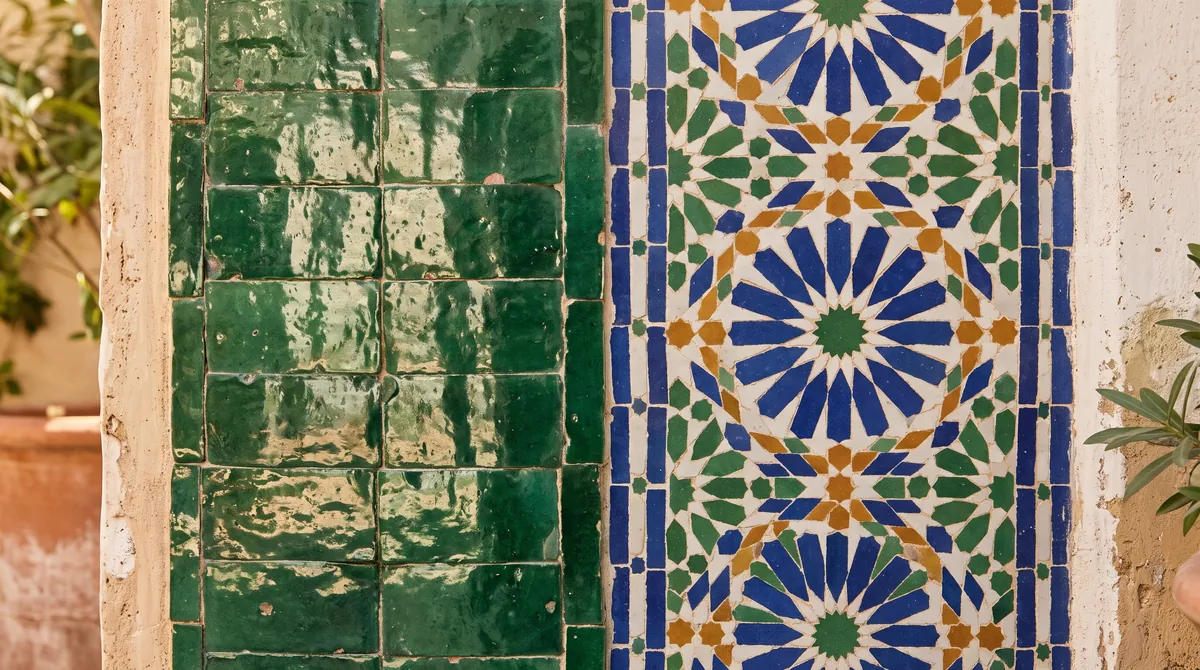
In the courtyard of an old house in Fez, the fountain is the quietest sound in the city. Water slips over a basin lined with tiny pieces of glazed clay, deep green, white, honey and blue, cut into stars and set so close together that the pattern seems to have no end. As the sun moves, each piece catches the light at a slightly different angle, so the wall never looks the same twice. Run your hand across it and you feel the reason: nothing here is perfectly flat.
A mosaic cut by hand
Zellige, also written zellij, is Moroccan tilework made of individually hand-cut pieces of glazed terracotta, set in geometric patterns. It has been a tradition of Fez for many centuries, and it belongs to the wider geometric art of al-Andalus and the Islamic world, where patterns based on stars and polygons cover walls, fountains, floors and columns. If you have walked through the old palaces and courtyards of southern Spain, you will recognise the family resemblance at once.
The patterns are built from a small number of shapes repeated with great discipline. A star at the centre radiates outwards into interlocking polygons, and the composition can grow to cover a whole wall without ever losing its order. Seen from a distance it reads as a single, calm surface; up close it dissolves into hundreds of separate pieces, each one placed by hand.
The maâlem and the hammer
The cutting is done by master craftsmen, the maâlem, who shape each piece from a glazed tile with a sharp hammer. Stroke by stroke, the tile is chipped into a star, a lozenge or a tiny triangle, the edges cut at a slight angle so that the pieces sit tightly together. It is slow, exact work learned over many years, and the precision of the finished pattern is the measure of the hand that cut it.
This is why a true cut mosaic is a commission rather than a product. It is designed for one wall, one fountain or one floor, and the pattern has to be worked out in advance so that the stars meet cleanly at the edges and corners.
From Fez clay to glaze
Much of the character of zellige comes from the way the tiles themselves are made, before any cutting begins.
- Clay from the region of Fez is prepared and shaped into tiles by hand.
- The tiles dry in the sun, which leaves them slightly warped and uneven.
- They are fired a first time, then glazed by hand.
- A second firing fuses the glaze to the clay.
- For mosaic work the glazed tiles are then cut into pieces; for square zellige they are sorted and used as they are.
Every step leaves a trace. The glaze is thicker in some places and thinner in others, so the colour deepens where it pooled and lightens where it ran thin. The surface undulates gently. Small chips at the edges and tiny pinholes in the glaze are part of the character, not faults.
Square zellige for today’s houses
Alongside the intricate cut mosaics, many people now use square zellige tiles, often about 10 by 10 cm and handmade in the same way. They bring the shimmer of the craft to a kitchen or bathroom without the complexity of a full mosaic. Because there are plenty of look-alikes, it helps to know what you are looking for.
- An uneven surface. Hold a tile to the light and it should ripple slightly; industrial imitations are flat and uniform.
- Glaze that varies. Each tile differs in depth of colour, sometimes within one box, sometimes within one tile.
- Clay at the edges. The glaze stops short of the edges or runs over them unevenly, showing the fired clay beneath.
- Small chips and pinholes. A few are normal and welcome; a perfectly crisp, identical tile is almost always made by machine.
Imitations have their uses, and they are easier to lay, but they do not catch the light in the same way. The shimmer of real zellige comes precisely from its imperfection.
The shimmer of real zellige comes precisely from its imperfection.
Where zellige works
Zellige is at its best where light and water play over it. On walls and splashbacks it gives a kitchen depth and movement; in a shower it turns everyday water into something to watch; around a fountain or a small pool in a courtyard it is the traditional choice. On floors, use only tiles with a glaze suitable for walking on, and think about slip resistance in wet areas. A single wall of zellige behind a basin or a cooker often does more than a whole room of it.
Colour matters as much as placement. Whites and creams vary gently and suit calm rooms; deep greens, blues and ox-blood reds show the variation strongly and suit small, bold surfaces. Mixing two close shades on the same wall adds even more life, as long as you shuffle them thoroughly rather than laying them in blocks.
Laying, sealing and care
Laying zellige is a job for experienced tilers who are used to handmade tiles. The tiles are set close together with narrow joints, and a good tiler accepts the variation rather than fighting it: the uneven surface is what catches the light, so it should not be forced flat. Because thickness varies from tile to tile, the bed has to take up the differences. The joints and the exposed clay edges are sealed, so that grout residue and later stains do not soak into the porous clay.
Care is gentle. Wipe with water and a mild cleaner, and avoid abrasive pads and harsh chemicals, which can damage the fragile glaze edges and the sealing in the joints. In a shower, wipe the walls down now and then, and renew the sealing on the joints when they begin to darken with water.
Questions and answers
Why does every zellige tile look different?
Because each one is shaped and glazed by hand from local clay, dried in the sun and fired twice. Glaze thickness, firing and the slightly uneven surface all vary, which is exactly what gives a wall its depth.
Can zellige be used in a shower?
Yes, zellige has long been used around water and works well in showers. The joints and clay edges need to be sealed, and the tiles cleaned with mild products only.
Are chips and pinholes a defect?
Small chips at the edges and pinholes in the glaze are part of the character of handmade zellige. Large cracks or loose glaze are not, and such tiles are best set aside for cuts.
Can I put zellige on the floor?
Only tiles with a glaze made for floors, and with care in wet areas, where a glossy surface can be slippery. Many people keep zellige for walls and choose a different tile underfoot.
Further reading in our network
- ronerisBespoke craft and manufactories
Bespoke craft and manufactories, with makers who still shape, glaze and fire by hand.
- GareliaArt, galleries and design
Art, galleries and design, including the geometric traditions that inspire contemporary work.
Our articles are general information written with care. Building work, roof loads, electrics, gas and fire need qualified professionals and local permits; plant care depends on your own climate and soil.