
Dry stone walls: an ancient craft of the Mediterranean
No mortar, only weight, friction and patience: how dry stone walls stand for generations, why they shape whole landscapes, and how to build a low one in your garden.
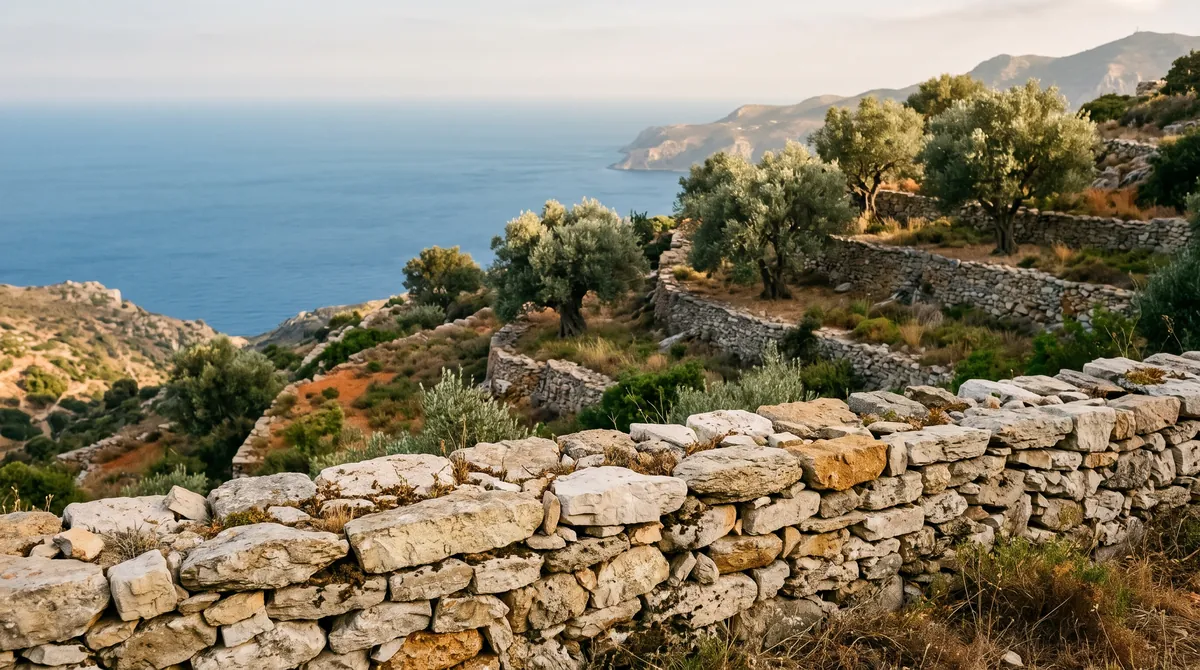
On a path above Sóller in the late afternoon, the terraces step down the mountain like the seats of an amphitheatre. Each one is held by a wall of grey limestone, laid without a trace of mortar, and on each stand olive trees older than anyone can remember. Put your palm flat on the stones and they are still warm from the day. A lizard watches from a crack, then vanishes. Every stone here was chosen, turned and set by hand.
Building without mortar
Dry stone walling means building with stones alone, without mortar or concrete. The wall stands because each stone is placed with care: its weight pressing down, its faces touching its neighbours, its length running into the wall rather than along it. A well-built wall can settle slightly with the ground instead of cracking, and a fallen section can be rebuilt with the very same stones.
The anatomy is simple to describe and difficult to master.
- Two faces. A freestanding wall is really two walls built side by side, each with its best face turned outwards.
- A filling. The space between the faces is packed tightly with smaller stones, so that the faces cannot move inwards.
- Through stones. Long stones laid across the whole width bind the two faces together.
- A batter. The wall leans slightly inwards as it rises, wider at the base than at the top, so that its weight presses towards the centre.
- Coping stones. A row of stones along the top locks everything in place and sheds the rain.
Retaining walls on a terrace usually show only one face, set against the soil, with a generous layer of smaller stones behind it that lets water drain through rather than build up pressure. Every dry stone wall is a record of countless decisions, each one made with a stone in the hand.
Every dry stone wall is a record of countless decisions, each one made with a stone in the hand.
Terraces that hold a hillside
Across the Mediterranean, steep land has been made workable with terraces. The walls turn a slope into a staircase of level fields where olives, vines, almonds and vegetables can grow. They hold the soil when autumn storms would otherwise wash it down the valley, and they slow the water so that more of it soaks into the ground instead of running off. In a dry climate, that matters as much as the soil itself.
Terraces also need steady care. A wall that loses a few stones in winter should be mended before the gap grows, because water and roots widen every weakness. Abandoned terraces collapse slowly, and with them goes the soil they were built to hold.
Landscapes built by hand
Some of the most loved landscapes of the Mediterranean are, in effect, enormous works of dry stone. The Serra de Tramuntana on Mallorca, with its terraces, mule paths and stone huts, has been a UNESCO World Heritage cultural landscape since 2011. On the island, dry stone wallers are called margers, and their work runs from the shore to the high ridges.
In Liguria, Portovenere, the Cinque Terre and the islands have been World Heritage since 1997, and here the terraces of vines cling to steep slopes above the sea. In Puglia, the trulli of Alberobello, round houses with conical roofs of stone, have been World Heritage since 1996, a reminder that dry stone can make not only walls but whole homes.
A craft shared by many countries
In 2018 the Art of dry stone walling, knowledge and techniques was inscribed on the UNESCO Representative List of the Intangible Cultural Heritage of Humanity by Croatia, Cyprus, France, Greece, Italy, Slovenia, Spain and Switzerland. The listing honours not the walls themselves but the knowledge behind them: how to read a stone, where to place it, how to pass the skill on to the next generation.
That knowledge is surprisingly similar from one country to the next. Wallers on an island in the Aegean and in an Alpine valley would recognise each other’s work at once: the same respect for through stones, the same inward lean, the same dislike of a joint that runs straight up the face.
A home for lizards, insects and plants
A dry stone wall is full of gaps, and every gap is a home. Lizards bask on the warm faces and dart into cracks; beetles, spiders, solitary bees and snails shelter between the stones; small ferns, stonecrops and navelwort root in the joints, and in the south capers trail from old walls. Because stone stores the warmth of the day and gives it back at night, the wall also creates a small, sheltered climate along its foot, where seedlings often appear first in spring.
That is a good reason to keep old walls rather than replace them with concrete, and to leave a few crevices open when you build a new one.
A dry stone wall in your own garden
You do not need a mountainside to enjoy dry stone. Low walls are a satisfying project for a patient gardener: a retaining edge for a gentle slope, a raised bed for herbs, a seat warmed by the sun beside a terrace. Use local stone if you can; it looks right in the landscape, weathers like the walls around you and has not travelled far.
- Mark the line and dig a shallow trench down to firm ground, removing the topsoil.
- Set the largest stones as a foundation, long side running into the wall.
- Build both faces together, keeping the batter with a simple frame and string lines, and pack the middle tightly as you go.
- Place each stone so that it bridges the joint below it.
- Add through stones at regular intervals to tie the faces together.
- Finish with heavy coping stones that cover the full width of the wall.
Higher retaining walls are a different matter. A wall that holds back a bank of soil, especially after heavy rain, carries great loads, and if it fails it can injure people and damage buildings. For higher retaining walls, and for anything close to a house, a path or a road, bring in an expert waller or a structural engineer.
Questions and answers
How long does a dry stone wall last?
A well-built wall on firm ground can stand for generations, and many old terrace walls have done so. Walls fail mainly where stones were badly placed, the foundation was weak, or water and roots have pushed them out, and a damaged section can be rebuilt with the same stones.
Do I need permission to build a dry stone wall?
Low garden walls rarely need special permission, but rules vary from place to place, and protected landscapes and heritage areas may set strict requirements for stone and style. Check with your local authority before building, especially on a boundary or a slope.
What stone is best for dry stone walling?
Local stone is best: it suits the landscape, weathers like neighbouring walls and is usually easier to find. Flat, blocky stones are easier to build with than round ones, and you need a good mix of sizes, including long stones to bind the faces and heavy ones for the top.
Can I build a retaining wall myself?
A low retaining edge or a raised bed, yes, with patience and a good foundation. Higher retaining walls carry the weight of wet soil and need an expert, because a collapse can be dangerous.
Further reading in our network
- island mallorcaThe island atlas
The island atlas of Mallorca, with the paths, terraces and villages of the Tramuntana.
- ronerisBespoke craft and manufactories
Bespoke craft and manufactories, where traditional skills such as stonework are kept alive.
Our articles are general information written with care. Building work, roof loads, electrics, gas and fire need qualified professionals and local permits; plant care depends on your own climate and soil.