
Lime plaster and limewash: the oldest finish of the Mediterranean
From limestone to wall and back to stone again: how the lime cycle works, why lime walls breathe and glow, and how to limewash safely at home.
Walk through one of the white villages of Andalusia on a bright morning and the light comes at you from every side. The lanes are narrow, the shadows deep blue, the walls so white they almost hum. Here and there a doorway has just been freshened, the step still splashed, the air carrying the faintly mineral smell of wet lime. Look closely and the white is not flat at all: it is soft and slightly cloudy, built up from many thin coats, each a little different from the last.
From stone to stone: the lime cycle
Lime is one of the oldest building materials there is, and it works in a cycle that begins and ends with stone.
- Burning. Limestone, which is calcium carbonate, is burned at around 900 °C. It gives off carbon dioxide and becomes quicklime, calcium oxide.
- Slaking. Quicklime is slaked with water, a fierce reaction that releases a great deal of heat, and becomes slaked lime, calcium hydroxide, as a putty or a dry powder.
- Use. Slaked lime is mixed with sand into plaster, or thinned with water into limewash.
- Carbonation. On the wall, the lime slowly absorbs carbon dioxide from the air and hardens into calcium carbonate again.
That last step is what sets lime apart from modern paint. Lime does not dry like paint; it slowly turns back into stone. Instead of forming a film on top of the wall, it becomes a thin skin of limestone bound to it. This takes time, often weeks and months, and it needs a little moisture to happen, which is why lime goes onto a damp wall and is protected from fierce sun and drying wind while it cures.
Lime does not dry like paint; it slowly turns back into stone.
Why lime walls feel different
Anyone who has lived in an old house with lime walls knows the feeling: a calm surface that seems to glow rather than shine. The reasons are practical as much as aesthetic.
- Vapour permeable. Moisture can pass through lime, so old stone and brick walls can dry out instead of trapping damp behind a sealed skin.
- Strongly alkaline. Fresh lime is highly alkaline, which discourages mould on walls and ceilings.
- Mineral. Lime is made from stone and returns to stone, without plastic binders.
- Matt and cloudy. The surface is soft and matt, with gentle variations in tone that change with the light through the day.
Plaster, limewash and their polished relatives
Lime takes many forms, from a rough render on a garden wall to surfaces as smooth and cool as marble. Each has its own place in a Mediterranean house.
| Finish | What it is | Typical use | Character |
|---|---|---|---|
| Lime plaster | Slaked lime mixed with sand, applied in layers with a trowel | Interior and exterior walls over stone and brick | Soft, slightly textured, breathable |
| Limewash | Slaked lime thinned with water, brushed on in thin coats | Renewing walls, façades and village houses | Cloudy, matt, luminous white or tinted |
| Marmorino | Venetian lime plaster with marble dust, polished | Interiors and feature walls | Smooth and cool with a soft sheen |
| Tadelakt | Moroccan lime plaster, compressed and polished with a stone and soap | Bathrooms, basins and hammams | Silky, water repellent, gently mottled |
| Stucco | Fine lime plaster worked into smooth surfaces and ornament | Ceilings, cornices and decorative details | Crisp, fine, sculptural |
Polished finishes such as marmorino and tadelakt are skilled crafts; for these, a specialist plasterer is worth waiting for.
The tradition of whitewashing
In the white villages of Andalusia and on the Greek islands, whitewashing is more than maintenance. Walls, steps and courtyards are given a fresh coat, often every year, and the habit shapes the look of whole towns. The bright white reflects the summer sun and helps keep houses cooler, and each new coat fills hairline cracks and leaves the surface clean. Many coats over many years round off the edges of steps, sills and corners, as if the houses had been dipped rather than painted.
You do not need a village to borrow the idea. A terrace wall, a garden shed, an old brick barbecue or the inside of a courtyard niche can all be limewashed and refreshed each year in an afternoon, and the cost of a mistake is simply another thin coat.
Handle lime with respect
Lime is caustic. Wet lime, putty and limewash can burn skin and seriously damage eyes, and the dust from dry powder is just as harmful. That is no reason to avoid it, but it does mean working carefully, every time you open a tub.
- Wear waterproof gloves and eye protection, ideally goggles that close at the sides, whenever you mix, stir or brush lime.
- Cover arms and legs, and take extra care with splashes when you work overhead.
- Keep clean water close by; if lime gets into your eyes, rinse at once with plenty of water and seek medical help.
- Keep children and pets away while you work and until the tools are clean.
- Leave quicklime and slaking to professionals, and buy ready slaked lime as putty or powder.
For larger plastering jobs, damp old walls or historic façades, ask a plasterer experienced with lime. The material is forgiving on the wall but unforgiving in the wrong mix or on the wrong surface.
How to limewash a wall
Limewash only works on mineral surfaces that can absorb it: stone, brick, lime plaster and walls that have been limewashed before. It does not bond directly over plastic paints such as acrylic or emulsion, which have to come off first, or the wall needs preparing by a specialist. Indoors and outdoors, the method is the same.
- Brush the wall down to remove dust, loose material and old flaking coats.
- Put on gloves and eye protection, then stir the limewash well; it should be thin, often compared to milk.
- Dampen the wall with a fine spray of water so that it does not draw the moisture out of the limewash.
- Brush on a thin coat with a wide, soft brush, working it into the surface in all directions.
- Let it dry, dampen again and apply the next coat; several thin coats are better than one thick one.
- Protect fresh work from strong sun, rain and frost for a few days while it begins to carbonate.
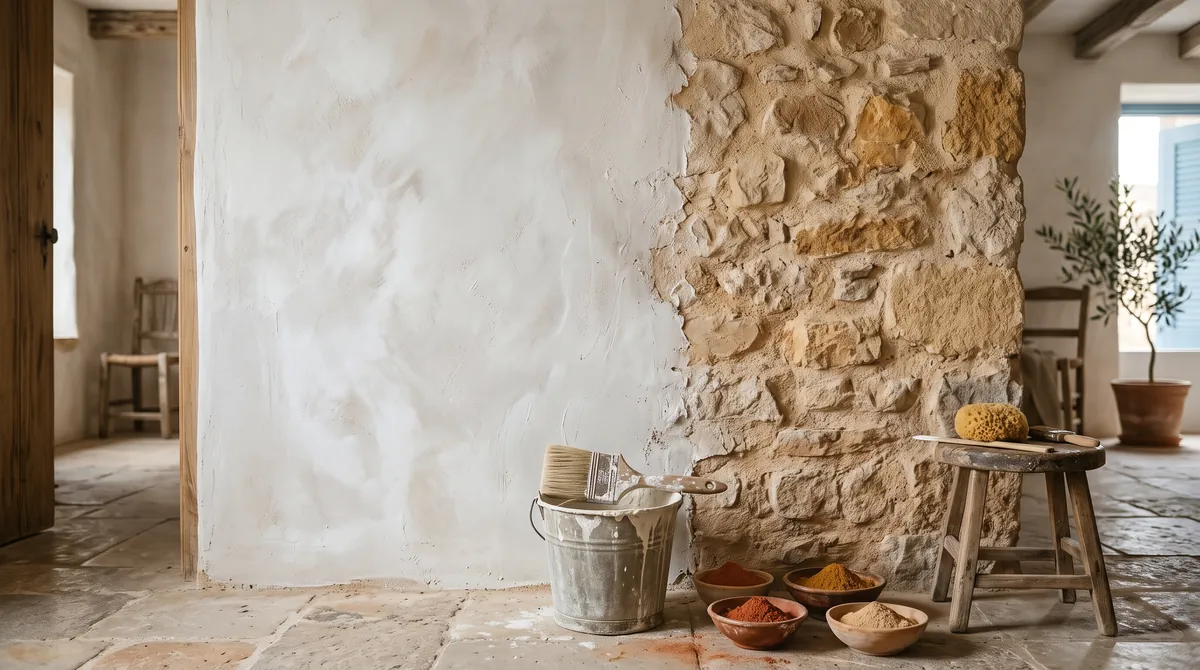
Do not be alarmed by the first coat: wet limewash looks almost transparent and greyish, and only turns white as it dries. Colours come from mineral pigments that are stable in lime, such as earths, ochres and oxides, which give the soft yellows, siennas and rosy pinks of southern façades. Pigments meant for ordinary paint may fade or react, so ask specifically for ones suitable for lime, and mix enough for the whole wall at once.
Questions and answers
Can I limewash over ordinary paint?
Not directly over plastic paints such as acrylic or emulsion, because limewash needs a mineral, absorbent surface to bond with. Old paint usually has to be removed, or the wall prepared by a specialist; ask which applies to your wall before you start.
Does limewash rub off?
Well-applied limewash on a suitable wall is durable, though a slightly chalky feel is part of its character, especially at first. Coats that are too thick or brushed on in hot sun are more likely to dust; several thin coats on a damp wall avoid this.
Is lime safe to use at home?
Once it has carbonated, a lime wall is simply a thin layer of stone. While you mix and apply it, lime is caustic, so always wear gloves and eye protection, cover your skin and keep children and pets away.
Can limewash be used outdoors?
Yes, lime finishes work indoors and outdoors, and limewash is the traditional coat for façades and garden walls in the south. Outside it weathers gently and is renewed from time to time, every year where whitewashing is a village tradition.
Further reading in our network
- MurosoArchitecture and interiors
Architecture and interiors, with old and new houses where mineral walls set the tone.
- ronerisBespoke craft and manufactories
Bespoke craft and manufactories, including makers who still work with traditional materials such as lime.
Our articles are general information written with care. Building work, roof loads, electrics, gas and fire need qualified professionals and local permits; plant care depends on your own climate and soil.