
Cement tiles: the patterned floors of old Mediterranean houses
Pressed, not fired, with colour that runs several millimetres deep: how encaustic cement tiles are made, where they belong and how to keep them beautiful.
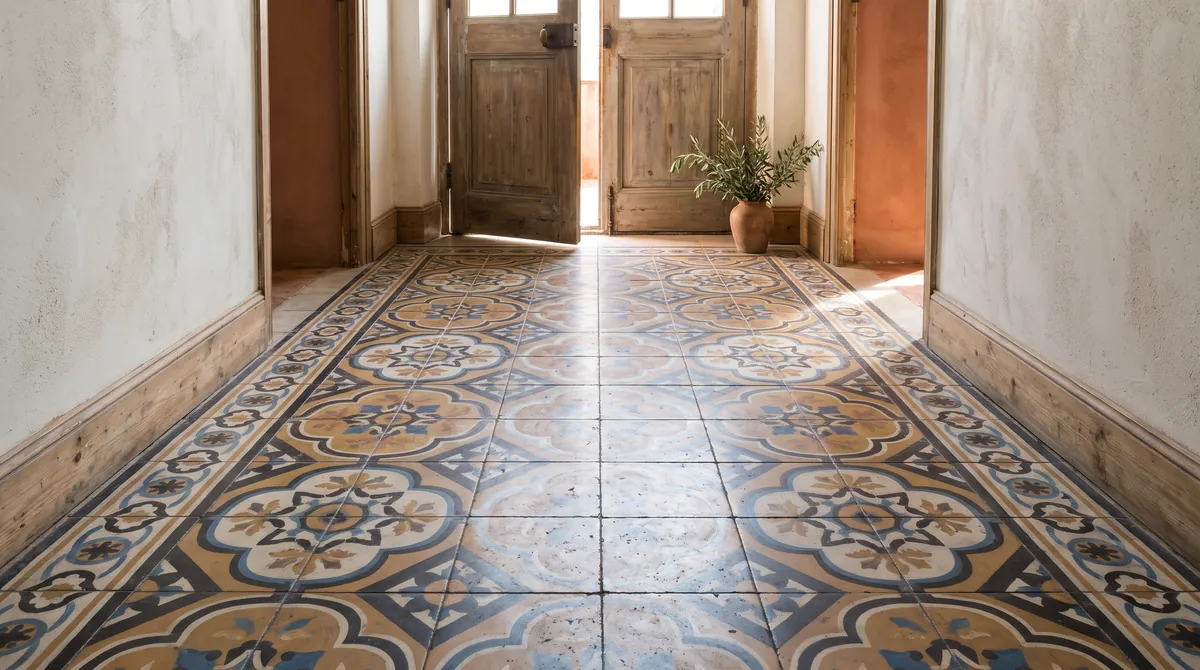
Push open the street door of an old apartment building in Barcelona and the hallway floor is often the first thing you see: a carpet of rosettes and stars in faded ox-blood, ochre and grey, framed by a band of interlacing lines. Generations of shoes have softened the colours without erasing them, and in the cool of the stairwell the pattern seems almost to float. These are cement tiles, and once you start noticing them you find them in kitchens, cafés and old family houses all around the Mediterranean.
A tile that never sees a kiln
Encaustic cement tiles go by many names: baldosas hidráulicas in Spain, carreaux de ciment in France, cementine in Italy. They appeared in the second half of the nineteenth century and became very popular in Spain, especially in Barcelona, in France and around the Mediterranean, and later also in North Africa and Latin America. They brought bold colour and pattern into ordinary homes, hallways and shops, and many of those floors are still walked on today.
The key difference from terracotta or glazed ceramic is that a cement tile is never fired. It gains its strength from cement that cures slowly, and its colour from pigment mixed right through a thick top layer rather than painted or glazed onto the surface. That one fact explains how the tiles look, how they age and how they must be treated.
How a cement tile is made
The process has changed little and is still largely done by hand, one tile at a time.
- A metal divider shaped like the pattern, rather like a pastry cutter with many compartments, is set into a square mould.
- Coloured cement, a mix of white cement, fine marble dust and pigments, is poured by hand into each compartment, colour by colour.
- The divider is lifted out with care, leaving the pattern in place, and backing layers of plainer cement are added on top.
- The tile is pressed in a hydraulic press, which compacts the layers into one solid piece.
- Finally the tiles cure slowly, sheltered from sun and draughts, until the cement has gained its full strength.
Because the coloured layer is several millimetres thick, the pattern wears slowly. A very old floor may be scuffed and dull, but the design is still there, and it can often be brought back. Hold a broken tile and you can see the layers in cross section: the bright face, then the grey body beneath.
Rosettes, borders and whole carpets
The patterns range from small geometric designs to large rosettes that only appear when four tiles meet, and on to borders and corner pieces that frame a room. Many old floors were composed as carpets of tiles: a patterned field in the centre, a border around it, and plain tiles running to the walls. That approach still works beautifully, and it is a good way to use a strong pattern without overwhelming a room.
- Draw it first. Lay out the pattern on paper or with loose tiles on the floor; rosettes and repeats change character depending on where they start and end.
- Combine with plain tiles. A rug of pattern in a kitchen or hallway, surrounded by plain tiles in one of its colours, feels calmer and often more authentic than pattern from wall to wall.
- Think about cuts. Place the pattern so that cut tiles fall at the edges, under furniture or in the plain border, never in the middle of a rosette.
- Use the walls too. Cement tiles make handsome splashbacks and dados, and a single row can frame a doorway or the foot of a wall.
Laying and sealing
Cement tiles are laid by experienced tilers on a level bed with fine joints, and they are less forgiving than they look. Adhesive or grout left on the face can stain the porous surface, so a good tiler works cleanly and wipes as they go. Once laid, the tiles must be sealed, because they are porous: oil, wine and lemon juice leave marks, and acids, including those in fruit juice and vinegar, etch the surface and dull the colour for good.
A good sealer soaks in, protects the colour and leaves the surface looking natural. Some deepen the colours a little, others keep them matt, so ask to see a sealed sample before the whole floor is treated. When water no longer beads on the surface but darkens it, the sealing needs to be renewed.
Living with a cement tile floor
Daily care is simple, as long as you know what to avoid. Most damage to these floors comes not from wear but from the wrong cleaning product used with the best intentions.
- Sweep or vacuum often, because grit scratches the sealed surface.
- Mop with water and a neutral cleaner; a few drops of mild soap are enough.
- Never use acids, vinegar, limescale removers or bleach, which etch the cement and attack the pigments.
- Wipe up oil, wine, coffee and citrus straight away, even on a sealed floor.
- Put felt pads under chair legs and a mat inside the door.
Over the years a well-kept floor gains a soft sheen, and the slight wear along the busiest paths, from the door to the table, from the table to the stove, becomes part of its charm.
Restoring old floors and finding reclaimed tiles
Many people discover cement tiles when they buy an old flat and lift the vinyl or carpet. Under years of grime and old wax the colours can look hopeless, but because the coloured layer is several millimetres thick, a specialist can grind the surface back, removing stains, scratches and a thin layer of the worn face, and then seal it again. The result can look close to new while keeping the character of the original floor. Because the colour runs several millimetres deep, an old cement tile floor is rarely lost, only hidden. Grinding is work for professionals, though: done badly, it can cut through the pattern.
Because the colour runs several millimetres deep, an old cement tile floor is rarely lost, only hidden.
Reclaimed tiles, lifted from old buildings and cleaned, are another way to bring the real thing into a newer house. Check that there are enough of one pattern for the room, that the thickness is consistent, and that the backs are free of old mortar that would stop them sitting level.
Where cement tiles belong
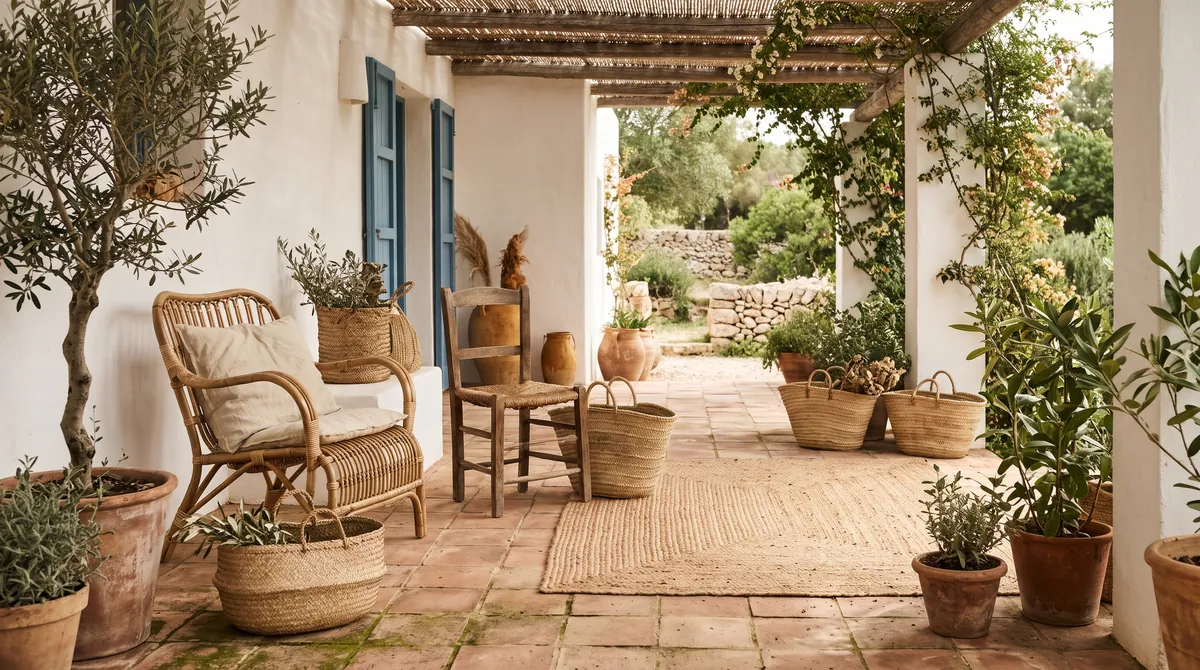
Cement tiles are at home on floors, walls and splashbacks, in kitchens, hallways, bathrooms and living rooms. In a shower or behind a sink they need careful sealing and regular attention. Outdoors, use them only under cover and where there is no frost, on a porch, a loggia or a covered terrace. Left open to the weather, the porous tiles take up rain, stain easily and, in a freezing winter, can crack.
Questions and answers
What is the difference between cement tiles and ceramic tiles?
Ceramic tiles are fired in a kiln and often glazed; cement tiles are pressed and cured without firing, and their colour sits in a thick top layer of coloured cement. That makes them more porous, so they must be sealed, but it also means the pattern wears very slowly.
Can I use cement tiles in a bathroom?
Yes, on floors and walls, including showers, as long as they are sealed with care and the sealing is renewed when water stops beading. Clean with neutral products only, because many bathroom cleaners contain acids.
How do I deal with a stain on a cement tile?
Act quickly and blot rather than rub, then clean with water and a neutral cleaner. Deep or old stains may need professional treatment; never reach for acids or bleach, which make things worse.
Can cement tiles go outside?
Only under cover and in places without frost. Exposed to rain and freezing nights, the porous tiles can stain and crack.
Further reading in our network
- ronerisBespoke craft and manufactories
Bespoke craft and the manufactories where tiles and other pieces are still made by hand.
- diseliaDesign, interiors and objects
Design, interiors and objects, from patterned floors to the furniture that stands on them.
Our articles are general information written with care. Building work, roof loads, electrics, gas and fire need qualified professionals and local permits; plant care depends on your own climate and soil.