
The wood-fired oven: one fire, a whole day of cooking
A dome of clay or brick that stores the heat of one fire and gives it back for hours. How a wood-fired oven works, how to cure and fire it, and what to cook as the heat falls.
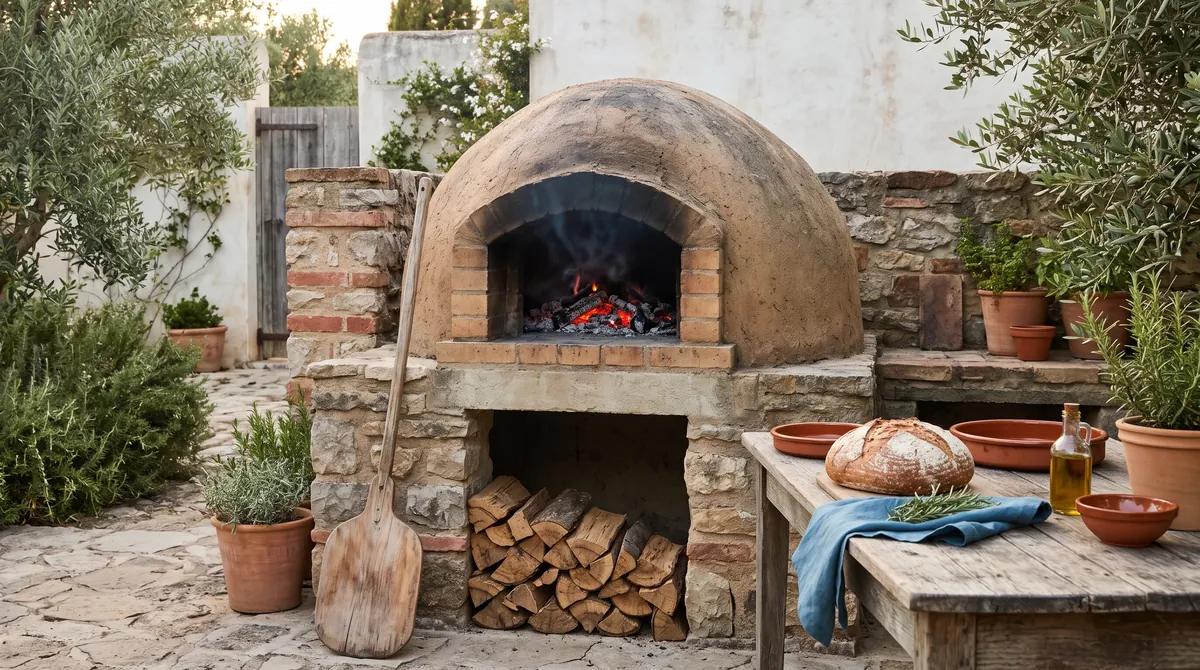
The olive wood has burned down to a glowing bed pushed against the side wall, and the inside of the dome has turned from black to pale, almost white, as the soot burns away. That change of colour is the oven telling you it is ready. A pizza slid onto the floor puffs and blisters in little more than a minute. Later, when the embers are raked out, a loaf takes its place, then a tray of peppers, and finally a pot of beans that stays in overnight. One fire, a whole day of cooking.
How the dome works
A traditional wood-fired oven is a simple and very old machine. A floor and a dome are built of clay, brick or refractory materials, and the fire burns inside the cooking chamber itself, not underneath it. While it burns, the curved dome reflects heat downwards onto the floor and the food, and the whole mass of floor and dome soaks up heat and stores it. That is why a well-built oven keeps cooking for hours after the last flame has died.
Food in the oven is cooked in three ways at once: by heat radiating from the dome, by heat conducted from the hot floor into the base of a pizza or loaf, and by hot air moving through the chamber. A layer of insulation around the dome and under the floor keeps the stored heat inside rather than letting it leak out through the outer shell. The doorway is usually noticeably lower than the inside of the dome, so that hot air and smoke circulate under the roof before they find their way out through the opening and the flue.
Curing a new oven slowly
A new oven still holds water in its clay, mortar and insulation. Light a big fire straight away and the water turns to steam faster than it can escape, and cracks appear. The answer is patience: several small fires that drive out the moisture slowly.
- Begin with a small fire of kindling and thin sticks near the door, and keep it going for an hour or two.
- Let the oven cool completely, then light a slightly larger fire the next day.
- Increase the fire a little each time over several days, moving it gradually towards the centre.
- Watch the outer shell: while steam or damp patches appear, keep the fires moderate.
- Only when the oven stays dry should you bring it up to full pizza heat.
Fine surface cracks in the outer render are not unusual and are often only cosmetic. Wide or growing cracks in the dome itself are a matter for an experienced oven builder, and so is the flue, if your oven has one.
Which wood to burn
The best fuel is dry hardwood: olive, oak or the prunings of almond trees, which is why so many Mediterranean ovens are fed from the family’s own groves and orchards. Split it, stack it under cover with air around it and let it dry well before use. Dry wood lights easily and burns hot and bright with little smoke; damp wood hisses, smokes and cools the oven instead of heating it. Small, split pieces also bring the heat up faster than heavy logs.
Never burn treated, painted or varnished wood, old furniture, chipboard or pallets whose treatment you do not know. They can give off fumes that you do not want anywhere near food, and their residue settles on the very floor where your bread will bake.
Cooking down the heat
The real skill of the wood-fired oven is to cook in the order of falling temperature. You light one fire, take the oven to its peak and then let each stage of cooling do a different job. The art is to follow the heat down, not to fight it.
| Stage | Oven heat (about) | What to cook |
|---|---|---|
| Fire still burning at the side | 430 to 480 °C | Neapolitan pizza in about 60 to 90 seconds, flatbreads |
| Embers raked out, door closed, heat evened out | 220 to 260 °C | Bread, focaccia, large country loaves |
| Falling heat | 160 to 220 °C | Roasts, whole fish, trays of vegetables and potatoes |
| Low heat, door closed overnight | 100 to 150 °C | Beans, stews and braises in terracotta pots |
| Last warmth the next day | below 80 °C | Drying herbs, tomatoes or slices of fruit |
Guide values only: every oven behaves differently. An infrared thermometer reads the surface of the floor or dome, not the air.
Pizza at the hottest stage is a craft of its own. Neapolitan pizza bakes in about 60 to 90 seconds at around 430 to 480 °C, and in 2017 UNESCO inscribed the Art of Neapolitan Pizzaiuolo as intangible cultural heritage, recognising the skill of the hands that stretch, top and turn it. At that heat the side facing the flames colours first, so turn the pizza with the peel once or twice while it bakes.
For bread, rake out the embers, sweep the floor and close the door so that the heat evens out between dome and floor before you load the loaves. Roasts and vegetables follow as the temperature drops. For slow dishes, put beans, water, herbs and a little olive oil into a terracotta pot, seal the door and leave it overnight. Bring terracotta up to temperature gently and do not put a cold pot into a hot oven, because sudden changes of temperature can crack it. By the next morning the oven is still warm enough to dry herbs or fruit.
The village oven
Baking bread was not always a private affair. Many villages once shared a communal oven, and in France the four banal of feudal times belonged to the lord, whose people had to bake there and pay a due for it. Where an oven is shared, the heat is used in turns, one batch after another, which is the same falling-temperature logic in a social form. Something of that spirit belongs to any oven at home: it shines when you cook for many, and a firing is a good reason to invite the neighbours.
Tools and safe habits
You need only a few tools, but they should be long and sturdy, because you work close to great heat.
- A peel: a wooden one for sliding pizza and bread in, and a smaller metal one for turning and lifting.
- A rake: for pushing embers to the side or drawing them out of the oven.
- A brush: with a long handle, for sweeping ash from the floor before you bake.
- An infrared thermometer: not essential, but it helps you learn how your oven behaves.
- Heavy gloves and a metal bucket with a lid: for handling hot tools and carrying away ash and embers.
Fire safety comes with the oven. Build or place it at a good distance from vegetation, keep the area around it clear of dry leaves and stacked firewood, and never leave a fire alone, even when it seems to have died down. Ash and embers stay hot for a long time, so put them in a metal container, never in a plastic bin. Many regions restrict open fires in dry periods to prevent wildfires, so check the local rules before a summer firing, and if you are building an oven, have its position and flue planned with a qualified builder.
The art is to follow the heat down, not to fight it.
Questions and answers
How long does a wood-fired oven take to heat up?
It depends on the size and mass of the oven and on how dry your wood is. A small, well-insulated oven heats up much faster than a large, heavy one. The dome turning from black to pale as the soot burns off is a good sign that it is ready for pizza.
Why did my new oven crack?
Usually because it was heated too fast before it was fully dry, so moisture turned to steam inside the walls. Cure a new oven with several small fires that grow slowly. Fine cracks in the render are often cosmetic, but wide or growing cracks in the dome should be looked at by an experienced oven builder.
Can I cook more than pizza?
Far more. As the oven cools after the pizza, it bakes bread, then roasts meat, fish and vegetables, and finally cooks beans or stews slowly in terracotta pots overnight. The last warmth can dry herbs, tomatoes or fruit.
Which wood should I never burn?
Never burn treated, painted or varnished wood, chipboard, old furniture or pallets whose treatment you do not know. They can give off fumes you do not want near food. Stick to dry hardwood such as olive, oak or almond.
Further reading in our network
- berbecuGrilling and barbecue
Everything about grilling and cooking over live fire, from fuel and heat zones to the right tools.
- cucianaItalian fine dining in Europe
Italian fine dining and the kitchen traditions behind it, from Naples to the north.
Our articles are general information written with care. Building work, roof loads, electrics, gas and fire need qualified professionals and local permits; plant care depends on your own climate and soil.