
Ceramics for the table: majolica, terracotta and painted plates
From the lustreware of medieval Spain to the painted plates of Sicily: how tin-glazed earthenware travelled the Mediterranean, and how to buy, use and care for ceramics on your own table.
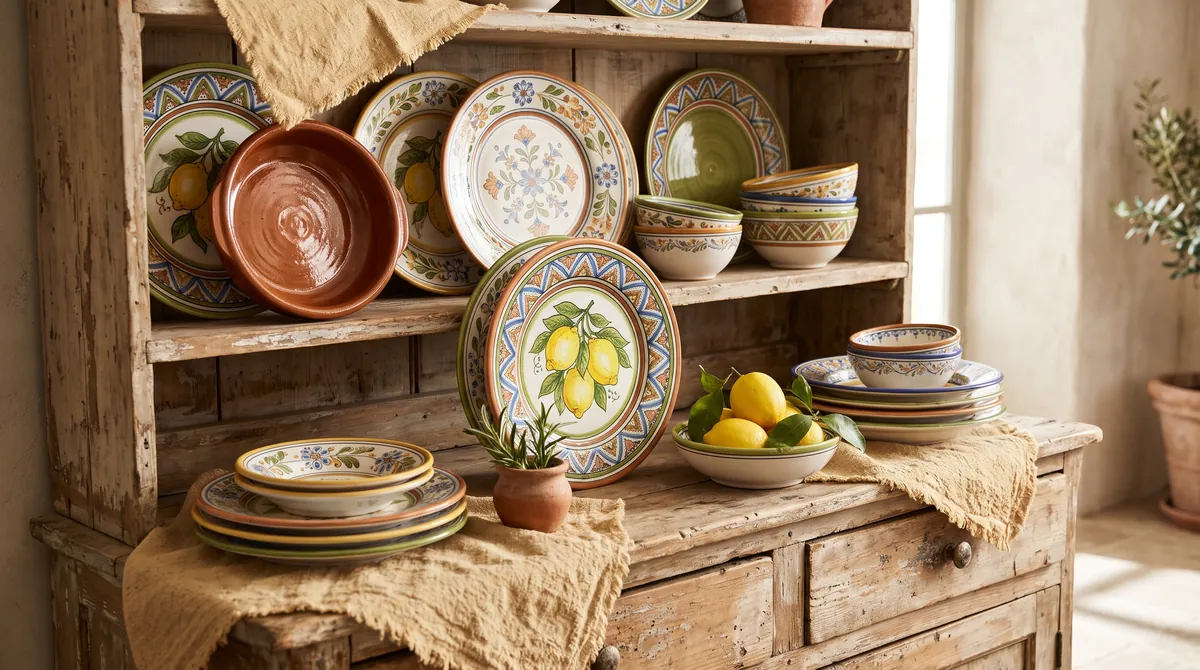
Turn an old painted plate over and part of its story is written on the back. Where the glaze stops at the foot ring you see the clay itself, pinkish or buff and soft enough to chip. On the front, a thick milky white carries a lemon, a cockerel or a spiral of blue leaves, the brushstrokes still visible where the painter loaded the brush. That white is the secret of a whole family of Mediterranean pottery, and once you know how it is made, you start to recognise it on tables from Valencia to Sicily.
The white that carries the colour
Most painted tableware of the Mediterranean is tin-glazed earthenware. The clay body is fired, then coated with a glaze made opaque and white by tin oxide, and the colours are painted directly onto that white surface before a second firing fuses paint and glaze together. The raw glaze is powdery and absorbent, and it takes up the paint at the first touch, so every brushstroke is final. There is no rubbing out, which is why the best pieces have such quick, fluent lines.
The palette comes from metal oxides that survive the heat of the kiln: cobalt for blue, copper for green, manganese for purple and brown, antimony and iron for yellows and oranges. That is why the same family of colours turns up again and again, on Spanish tiles as much as on Italian jugs, and why old and new pieces so often sit well together.
A glaze that travelled the sea
The technique of tin glazing spread from the Islamic world to Spain. In the Middle Ages the lustreware of Málaga and of Manises near Valencia became famous, its decoration given a metallic shimmer in an extra firing. From Spain the wares and the know-how moved on, and each country that took them up gave them a name of its own.
- Maiolica in Italy, a name often explained by Majorca, the island through which Spanish wares were shipped.
- Faience in France, named after Faenza, the Italian town whose pottery was widely admired.
- Delftware in the Netherlands, where potters used the same white glaze for their own wares.
The words are worth knowing because they describe one basic idea, an opaque white glaze painted with colour, carried along trade routes and changed by every place that adopted it. In English the Italian word is often spelt majolica, and you will meet both spellings when you shop.
Ceramic towns of the Mediterranean
Some towns have lived with their kilns for generations, and a visit shows how distinct each style has become. These are worth knowing by name:
- Deruta in Umbria, a hill town long associated with painted maiolica.
- Faenza in Emilia-Romagna, the town that gave faience its name.
- Caltagirone in Sicily, where the risers of a long town staircase are faced with painted tiles.
- Vietri sul Mare on the Amalfi coast, known for cheerful, brightly painted wares.
- Talavera de la Reina in Spain, with its long tradition of painted tiles and tableware.
- Moustiers-Sainte-Marie in Provence, a centre of finely decorated faience.
- Iznik in Turkey, whose historic tiles and dishes with tulips and carnations belong to a related but distinct tradition.
In 2019 UNESCO inscribed the making process of the ceramics of Talavera de la Reina and El Puente del Arzobispo in Spain, together with the artisanal talavera of Puebla and Tlaxcala in Mexico, as intangible cultural heritage. The joint inscription is a reminder that the craft did not stop at the coast. It crossed the Atlantic and took root there too.
Terracotta that goes into the oven
Not every useful pot is painted. The Spanish cazuela, a shallow round dish of fired clay, often glazed only on the inside, goes straight from the oven to the table and keeps food warm long after serving. Unglazed terracotta needs a little care, and it rewards that care with years of use.
- Soak a new unglazed dish in water before its first use, ideally for several hours.
- Put it into a cold or gently warming oven rather than a very hot one.
- Avoid sudden temperature changes: never pour cold liquid into a hot dish, and never set a hot dish on cold stone or a wet surface.
- Rest it on a wooden board or a folded cloth when it comes out.
- Wash it with hot water and a brush, using little or no detergent on unglazed surfaces, which absorb it.
Used over a flame, start with low heat and raise it slowly. A cazuela that has been treated this way darkens with age and becomes one of the most loved things in the kitchen.
Food safe or for the wall?
Old or purely decorative glazes may contain lead. Antique plates, souvenir pieces and anything sold as decorative belong on the wall, on a shelf or under a pile of whole lemons, not under a salad dressed with vinegar. Eat only from pieces sold as food safe, and if you are unsure, ask the maker or the seller before you buy. A good seller knows the difference and will tell you plainly.
Care, and the art of mixing patterns
Tin-glazed earthenware is softer than porcelain, and its rims chip more easily. Hand wash painted pieces in warm water, because the heat and detergent of a dishwasher dull glaze and decoration over time. Stack plates with a cloth or a piece of felt between them, and do not leave chipped pieces soaking, as the exposed clay takes up water.
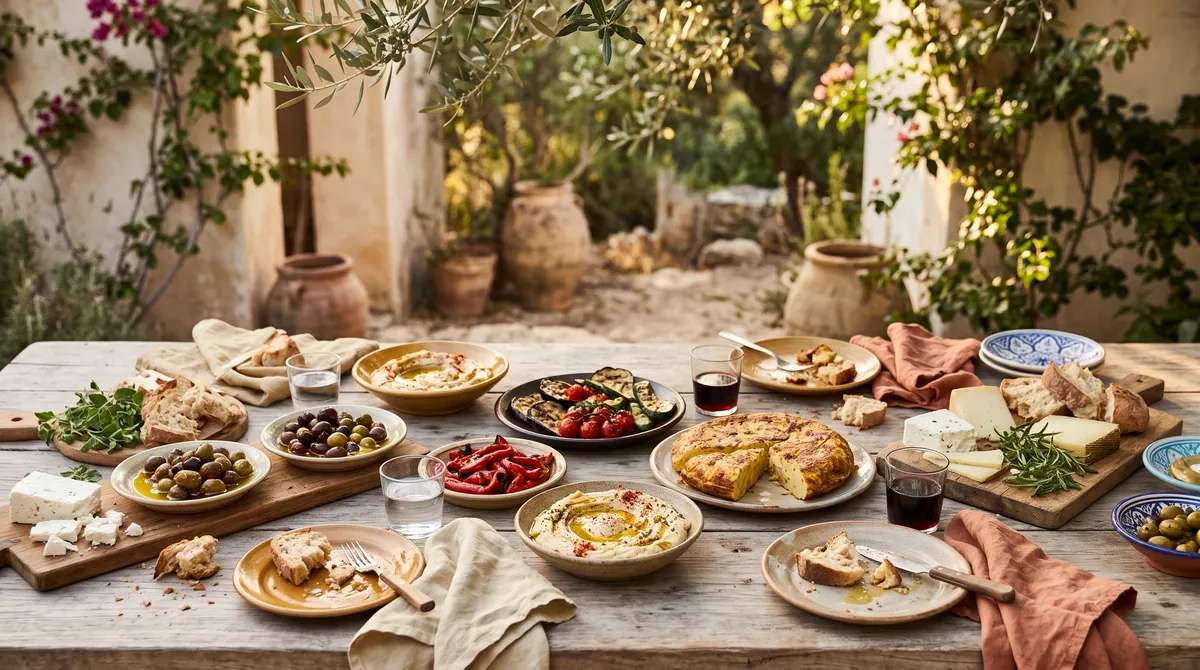
On the table, painted ceramics are at their best when they are mixed. Patterns from different towns and decades sit happily together if one colour runs through them all: a Sicilian lemon plate, a blue and white bowl from Spain and a plain terracotta dish can share one meal. Combine patterned and plain, large and small, and let the food add its own colours. A bold platter in the middle, plain plates at each place and a few painted bowls for olives and salt make a table that looks gathered over years.
The raw glaze takes up the paint at the first touch, so every brushstroke is final.
Questions and answers
What is the difference between maiolica, faience and delftware?
They are names for the same basic technique, tin-glazed earthenware painted with colours, used in different countries. Maiolica is the Italian name, faience the French one, after the town of Faenza, and delftware the Dutch. Each tradition developed its own shapes, colours and motifs.
Can I put painted ceramics in the dishwasher?
It is better not to. Heat and detergent dull the glaze and decoration over time, and earthenware chips more easily than porcelain. Hand wash painted pieces in warm water and dry them well.
Are old painted plates safe to eat from?
Not necessarily. Old or purely decorative glazes may contain lead, so use such pieces for display. Eat only from ceramics sold as food safe, and ask the maker or seller if you are unsure.
How do I prepare a new terracotta cazuela?
Soak a new unglazed dish in water before its first use, then start it in a cold or gently warming oven. Avoid sudden temperature changes, such as cold liquid poured into a hot dish or a hot dish set down on cold stone.
Further reading in our network
- cucianaItalian fine dining in Europe
Italian fine dining and the regional kitchens whose dishes look their best on painted plates.
- GareliaArt, galleries and design
Art, galleries and design, including the crafts and objects that sit between the two.
Our articles are general information written with care. Building work, roof loads, electrics, gas and fire need qualified professionals and local permits; plant care depends on your own climate and soil.